PSA (Pressure Swing Adsorption) nitrogen molecular sieve plays a core role in the industrial gas industry for nitrogen production, especially in the field of nitrogen preparation, where it holds an irreplaceable position. Its effective, energy-saving, and flexible characteristics make it the mainstream choice for small and medium-sized nitrogen use scenarios, while gradually penetrating into large-scale industrial applications. The following is a detailed analysis of its key position and advantages:
1. Core position in the industrial gas industry
One of the mainstream nitrogen production technologies:
PSA technology, along with Cryogenic and Membrane separation, is one of the three major industrial nitrogen production methods. Among them, PSA occupies the main share of the small and medium-sized market (purity ≤ 99.999%) due to its high comprehensive cost-effectiveness.
Wide application coverage:
From chemical, electronic, food packaging to pharmaceutical, metallurgical and other industries, PSA nitrogen producing molecular sieves can meet different purity requirements (95%~99.999%), especially suitable for dispersed and on-site nitrogen generation scenarios.
Alternative to traditional nitrogen supply mode:
Gradually replacing the transportation of liquid nitrogen tanks/steel cylinders, reducing logistics costs and supply chain risks, and promoting the transformation of the gas industry towards distributed production.
2.The core role and technological advantages of molecular sieves
Key materials for adsorption performance:
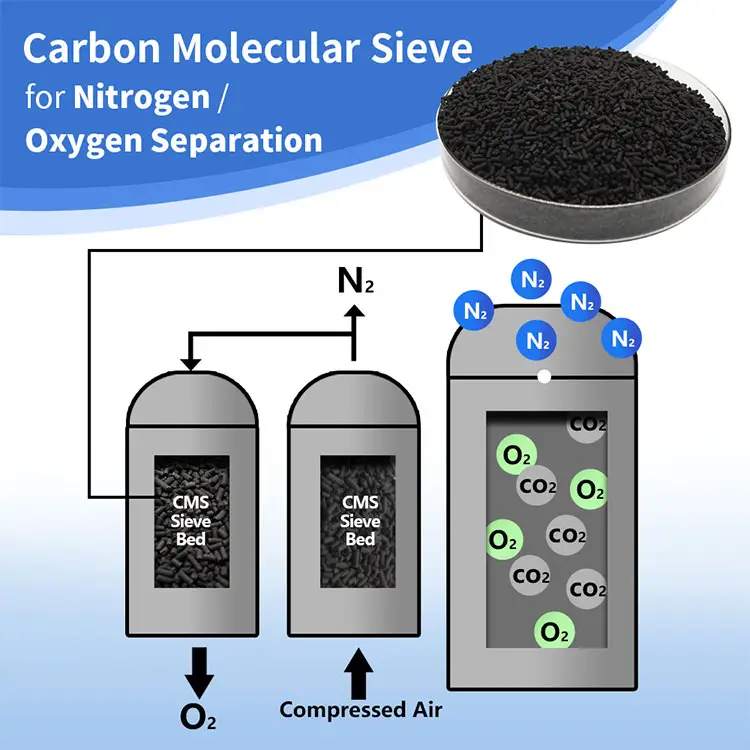
The core of PSA nitrogen production is molecular sieves (commonly carbon molecular sieves CMS or zeolite molecular sieves), which selectively adsorb oxygen (O ₂), carbon dioxide (CO ₂), and water (H ₂ O) to purify nitrogen gas (N ₂).
Carbon molecular sieve (CMS): preferentially adsorbs O ₂, suitable for purity below 99.5%.
Zeolite molecular sieves (such as Li LSX): used in high-purity (≥ 99.999%) scenarios, but at a higher cost.
Technical advantages:
Low energy consumption: Compared to cryogenic air separation, PSA reduces energy consumption by 30% to 50% (especially suitable for small and medium flow rates).
Quick start stop: No need for pre cooling, qualified nitrogen can be produced within 30 minutes.
Modular design: can flexibly expand production capacity and adapt to fluctuating demands.
3.Market driven factors of PSA Nitrogen Molecular Sieve
Cost effectiveness:
The cost per ton of nitrogen produced by PSA (0.1~0.3 yuan/Nm ³) is significantly lower than that of liquid nitrogen (0.5~1.2 yuan/Nm ³), indicating outstanding long-term economic viability.
Environmental Protection and Safety:
Reducing transportation carbon emissions and avoiding the low temperature risk of liquid nitrogen storage are in line with ESG trends.
Technological progress:
New molecular sieves, such as CMS doped with metal ions, enhance adsorption efficiency and extend their lifespan from 5 years to 8-10 years.
4.Challenges and Competition
Purity limit:
PSA nitrogen production purity is usually ≤ 99.999%, and ultra-high purity (such as electronic grade) still relies on cryogenic methods.
Raw gas requirements:
The need for clean compressed air increases the complexity of the pre filtration system.
Competition in membrane separation technology:
The membrane method has lower cost in low purity (95%~99.5%) scenarios, but PSA is more stable.
5.Future Trends
Research and development of high-performance PSA nitrogen molecular sieve:
Improve adsorption capacity and selectivity, and reduce energy consumption (such as continuous investment by giants like UOP and BASF).
Intelligent PSA system:
Combining AI algorithms to optimize adsorption cycles and dynamically adjust pressure to improve efficiency.
Green nitrogen production:
Coupling renewable energy sources (such as wind power compressed air) to achieve zero carbon nitrogen production.
Summary
PSA nitrogen production molecular sieve is a pillar technology for small-scale nitrogen production in the industrial gas field. With its flexibility, economy, and technological maturity, it will continue to maintain an important position in the future. With the innovation and system optimization of molecular sieve materials, their application scope is expected to further expand to higher purity and larger scale scenarios. For users, choosing PSA requires a comprehensive evaluation of factors such as gas consumption, purity requirements, and electricity costs, and a comparison of full lifecycle costs with cryogenic and membrane methods.