
描述
Introduction
The N₂ generation carbon molecular sieve (CMS) is an innovative gas separation technology that has gained significant attention in recent years due to its potential to revolutionize the way we handle and purify various gases, particularly nitrogen. This advanced material offers superior performance compared to traditional methods, making it an attractive solution for numerous industrial applications.

Background
Traditional gas separation techniques, such as cryogenic distillation and pressure swing adsorption (PSA), have been widely used for decades. However, these methods often suffer from limitations like high energy consumption, complex equipment, and narrow operating windows. The development of CMS aims to address these challenges by providing a more efficient and cost-effective alternative.

How Does It Work?
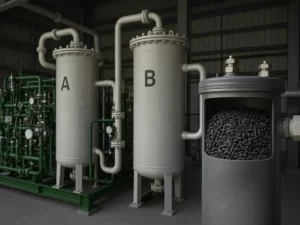
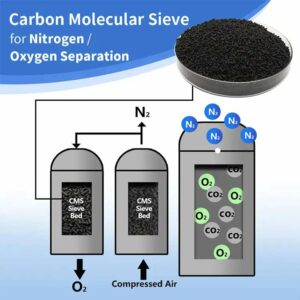
The N₂ generation CMS is based on the principle of molecular sieving, which allows specific gas molecules to pass through the material’s pores while blocking others. The key feature of this material is its unique pore structure, which is designed to selectively permeate nitrogen molecules while rejecting other gases, such as oxygen, carbon dioxide, and water vapor.
This selective permeation is achieved through a combination of factors, including pore size, surface chemistry, and mechanical strength. By precisely controlling these properties during the manufacturing process, researchers can tailor the CMS to target specific gas mixtures and operating conditions.
Advantages and Applications
The N₂ generation CMS offers several advantages over conventional gas separation technologies:
-
High selectivity: The material’s ability to selectively permeate nitrogen makes it ideal for applications requiring pure nitrogen, such as food packaging, medical gas production, and electronics manufacturing.
-
Energy efficiency: Compared to cryogenic distillation, CMS operates at moderate temperatures and pressures, resulting in lower energy consumption and reduced operating costs.
-
Simplicity: The CMS system typically requires less complex equipment and can be easily integrated into existing processes, making it a more streamlined solution for many industries.
-
Versatility: The material’s tunable properties allow it to be adapted for a wide range of gas separation applications, including air separation, natural gas purification, and biogas upgrading.
-
Long-term stability: CMS exhibits excellent mechanical stability and resistance to chemical degradation, ensuring reliable performance over extended periods.
Future Prospects
As research continues to advance the field of carbon molecular sieves. The N₂ generation CMS holds great promise for transforming various industries. By leveraging its unique capabilities, scientists and engineers can develop innovative solutions. To address pressing challenges related to energy efficiency, environmental sustainability, and resource management.
Conclusion
The N₂ generation carbon molecular sieve represents a significant breakthrough in gas separation technology. Offering superior performance and versatility compared to traditional methods. As this innovative material continues to mature and find new applications. It is poised to play a crucial role in shaping the future of the industry and addressing critical global issues.

评价
目前还没有评价