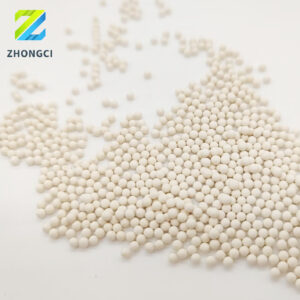
low silicon aluminum x-type zeolite Lix molecular sieve are widely used air separation agents, with advantages such as large ammonia adsorption capacity. It has high nitrogen oxygen separation coefficient, and easy desorption. In processes such as pressure swing adsorption separation (PSA) and vacuum pressure swing adsorption separation (VSA) ? All have applications. The most commonly used production process in industrial preparation is the aqueous solution exchange method. But it is difficult to achieve high exchange degree. And it is difficult lithium salt recovery during the exchange process. In view of this, this paper proposes a new method of combining aqueous solution exchange and high-temperature solid-phase exchange. This not only improves the exchange degree of lithium ions (96%), but also reduces the amount of lithium salt used. At the same time, the process is simple and easy to achieve industrialization.
The main conclusions of this paper are as follows:
The exchange frequency is 4 times, and the exchange time for each exchange is 2 hours. Under this exchange condition, the partial exchange degree of LiX molecular sieve obtained is over 96%, which basically meets the requirements of industrial applications. In the investigation of the exchange conditions of aqueous solution, after two exchanges, the ion exchange degree in the zeolite molecular sieve reached 86.6%. And the lithium ion utilization rates in the third and fourth exchanges were both very low, less than 10%. The zeolite molecules obtained from two water solution exchanges were as raw materials to achieve lithium ion exchange at the remaining cation positions using solid-phase exchange method. The optimal exchange conditions were obtain as follows. Ion exchange was out according to the following procedure. At room temperature, the temperature was raised to 120 ℃ at a gradient of 1 ℃/min for 120 minutes. Heat up to 200 ℃ at a temperature gradient of 1.33 ℃/min and maintain the temperature for 120 minutes. Then raise the temperature in a gradient of 2.5 ℃/min to 350 ℃, maintain a constant temperature for 180 minutes. And then naturally cool down.
Conlusions
The conclusions are as follows: 1. Through FT-IR characterization of the sample, we can see that the basic structural units that make up the zeolite molecules did not change, still dominated by S1.0 and A!, but due to the smaller size of lithium ions compared to sodium ions, their influence on the skeleton vibration was slightly different. For example, the peaks representing the internal stretching vibration of the tetrahedron moved from 664.75cm, 1 and 696.37cm to 668.70cm, and a small shoulder peak appeared near 696cm, while the peak representing the external stretching vibration of the tetrahedron moved from 742.42cm to 746.53cm~. The characteristic peak of double ring vibration is 557.48cml
Change to 584, 95cm. There are double and other objects of varying sizes appearing near the river;
2. Through TG and DTA analysis, we found that compared with the results reported in the literature, the dehydration peak shifted towards higher temperatures, indicating an increase in the water absorption capacity of the exchanged zeolite molecules and an increase in the collapse temperature of the framework, from less than 600% C to around 700 ℃, indicating an improvement in the thermal stability of the exchanged zeolite molecules.
XRD Analysis
- The XRD analysis results show that after exchange, the various characteristic peaks of the molecule tend to shift towards larger angles, indicating that the interplanar spacing (d value) is small. This is due to the small radius of lithium ions, which can completely enter the smaller cages of zeolite molecules. On the other hand, under the same charge, the smaller ion radius weakens the interaction force between ions and skeleton elements, causing the skeleton to shrink and the crystal cell to shrink. 4. Through SEM photos, we can see that the particle size of the molecular sieve remains unchanged before and after exchange, and the distribution range is narrow (~5pm) with clear contours, indicating that the ion exchange method has little effect on its morphology; 5. By comparing the aqueous solution exchange method and solid-phase exchange method, the LiX molecular sieve storage, FT-IR, TG-DTA, XRD, and SEM analysis characterization results show that there is no difference in structural component energy between the samples by these two methods.