Nitrogen Generators using Carbon Molecular Sieve (CMS), incorporating information from the provided search results:
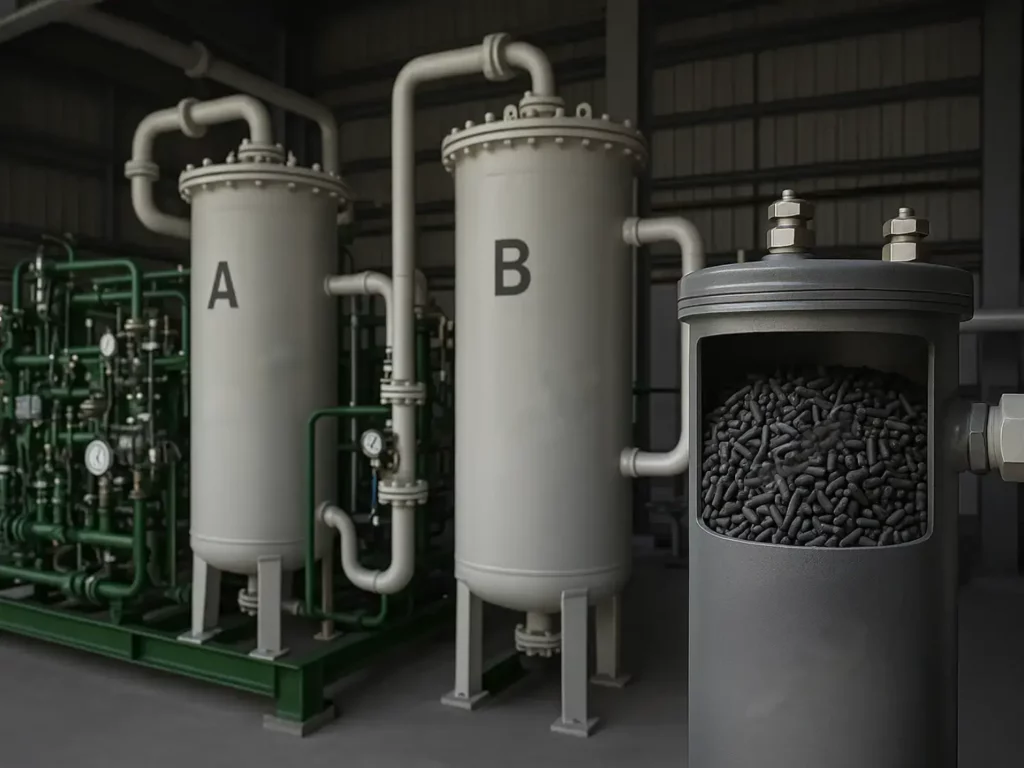
Nitrogen Generator Using Carbon Molecular Sieve (CMS): Technology and Applications
1. Introduction
A Nitrogen Generator utilizing Carbon Molecular Sieve (CMS) is an advanced system that produces high-purity nitrogen gas (N₂) directly from compressed air through Pressure Swing Adsorption (PSA) technology. This method is widely adopted across industries due to its efficiency, reliability, and cost-effectiveness compared to traditional cryogenic distillation or cylinder-based supply.
2. Core Technology: PSA with Carbon Molecular Sieve
- Principle: CMS exploits the kinetic diameter difference between oxygen (O₂) and nitrogen (N₂) molecules. Oxygen molecules (diameter ~3.46 Å) diffuse faster into the micropores of the CMS than nitrogen molecules (diameter ~3.64 Å) under pressure.
- Process:
- Adsorption: Compressed air is fed into one of two adsorption towers filled with CMS. O₂, CO₂, and moisture are rapidly adsorbed, allowing N₂ to pass through as the product gas.
- Desorption: Once the CMS in the first tower is saturated, the system switches airflow to the second tower. The first tower is depressurized to atmospheric pressure, releasing the adsorbed gases (primarily O₂) as waste.
- Purge & Repressurization: A small portion of product N₂ is used to purge the first tower, further cleaning the CMS. The tower is then repressurized, ready for the next cycle. This alternating cycle ensures continuous N₂ production.
3. Key System Components
- Air Compressor: Provides compressed feed air.
- Air Preparation Unit: Includes filters to remove oil, water, and particulates, protecting the CMS.
- Twin Adsorption Towers: Contain CMS adsorbent; operate cyclically (one adsorbing, one regenerating).
- Automated Control Valves & PLC: Precisely manage the pressure swing cycle and tower switching.
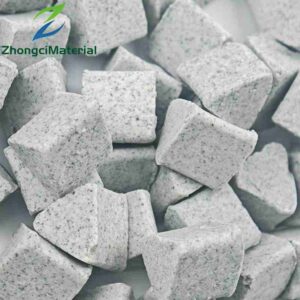
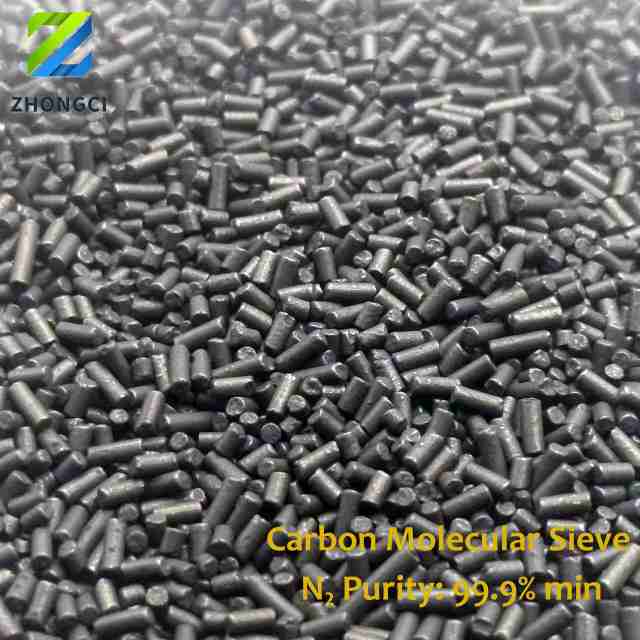
- Carbon Molecular Sieve (CMS): The critical adsorbent material, typically derived from specially processed carbonaceous precursors like coal or coke fines.
4. Advantages of CMS Nitrogen Generators
- On-Site Production: Eliminates dependency on delivered liquid nitrogen or cylinders.
- Cost Efficiency: Significantly lower operating costs compared to purchased nitrogen.
- High Purity Flexibility: Capable of producing nitrogen with purities ranging from 95% to 99.999%, adjustable based on application needs.
- Rapid Start-up: Generates nitrogen within minutes of activation.
- Low Maintenance: Robust design with automated controls minimizes manual intervention.
- Energy Efficiency: Optimized PSA cycles consume less energy per unit of N₂ produced than cryogenic plants for medium-scale requirements.
5. Applications
CMS nitrogen generators are versatile and used in diverse sectors:
- Food & Beverage Packaging: Blanketing to prevent oxidation and extend shelf life (e.g., Modified Atmosphere Packaging for snacks, coffee, juices).
- Chemical & Petrochemical: Inerting reactors, storage tanks, and pipelines to prevent fires and explosions.
- Electronics Manufacturing: Creating inert atmospheres for soldering and component production.
- Pharmaceuticals: Blanketing during drug synthesis and packaging.
- Metal Processing: Heat treatment furnaces (e.g., annealing, sintering) to prevent oxidation.
- Controlled Atmosphere (CA) Storage: Preserving fruits (e.g., apples) in cold storage facilities using nitrogen-rich environments to slow ripening.
- Enhanced Oil Recovery (EOR): On-site nitrogen generation for injection into oil wells to maintain reservoir pressure and improve oil displacement (“Nitrogen Making and Injection Device”).
6. Comparison to Alternative Technologies
- Membrane Separation: Uses permeable fibers where O₂ and H₂O vapor permeate faster than N₂. Generally simpler but often offers lower purity (typically <99.5%) and can be more sensitive to feed air conditions. CMS generators excel in achieving higher purities consistently.
- Cryogenic Distillation: Suitable for ultra-high purity and very large volumes, but involves high capital cost, complex operation, and slow start-up. CMS PSA is more economical for medium-scale, high-purity needs.
7. Material & Design Advancements
- CMS Development: Research focuses on optimizing CMS pore structure for higher selectivity and capacity. Studies explore using precursors like coke fines to produce efficient CMS.
- System Optimization: Modern designs incorporate advanced automation control systems. These enhance reliability, extend service life, simplify operation, and improve the accuracy and efficiency of nitrogen production. Computational tools like CFD (Computational Fluid Dynamics) are applied to optimize internal flow dynamics within the adsorption towers.
8. Future Outlook
Ongoing research explores Carbon Molecular Sieve Membranes (CMSM) for potential gas separation applications, leveraging molecular dynamics simulations to understand separation mechanisms. While primarily focused on future membrane technology, this highlights the continuous innovation in carbon-based separation materials.
Conclusion
Nitrogen generators based on Carbon Molecular Sieve PSA technology represent a mature, efficient, and adaptable solution for on-site nitrogen generation. Their ability to deliver high-purity nitrogen reliably and cost-effectively makes them indispensable across numerous industries, from food preservation to industrial safety and energy. Continuous improvements in CMS materials and system automation ensure their position as a leading technology for decentralized nitrogen production.