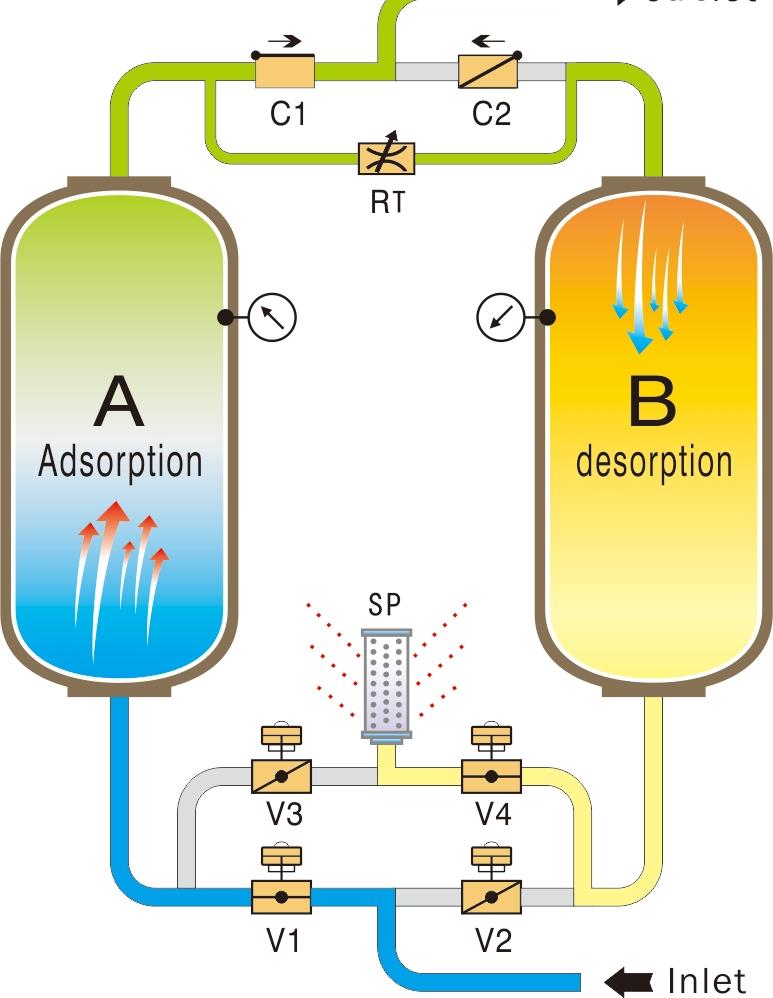
1.Usually, removing adsorbed water by heating or other methods to obtain its original water absorption capacity is called regeneration. Because molecular sieves become saturate with water and lose their ability to absorb and separate water from the mixture.
2. Various types of molecular sieves have different functions. After use, the original function weakens or disappears. What’s more, various effective methods are to remove adsorbents and restore the original function, which calls the regenerating of molecular sieves.
3. Molecular sieve Regeneration can often be multiple times.
- A method for regenerating molecular sieves, characterized by the following steps:
2.Add the poisoned molecular sieve into the regeneration solution, stir and soak, dry. Then activate the molecular sieve at high temperature under an inert atmosphere to obtain the regenerated molecular sieve;
3.The regenerating solution is a mixed solution of strong alkali and organic amine.
4. The regenerating method of the molecular sieve characterizes in that. The mass ratio of the strong base to the organic amine is 1:1 to 2.
5. The regenerating method of the molecular sieve characterizes in that the strong base is potassium hydroxide and sodium hydroxide in a mass ratio of 1:1 to 3. The organic amine is one or more of dimethylamine, diethylamine, dipropylamine, or non-butylamine.
6. The regenerating method of the molecular sieve characterizes in that the mass to volume ratio of solute to distilled water in the regenerating solution is 1:15-5000. Among them, the unit of mass is g, and the unit of volume is mL.
Generation Steps
7. The regenerating method of the molecular sieve characterizes in that the mass to volume ratio of the poisoned molecular sieve to the regeneration solution is 1:2-1000. Among them, the unit of mass is g, and the unit of volume is mL.
8.The regeneration method of the molecular sieve characterizes in that the stirring impregnation temperature is 25 ℃ to 90 ℃ and the time is 5min to 30min.
9.The regeneration method of the molecular sieve characterizes in that the drying adopts vacuum drying or heating drying. The pressure for vacuum drying is between 0.1KPa and 5KPa. The temperature for heating and drying is between 80 ℃ and 120 ℃.
10. The regeneration method of molecular sieve according to claim 1, characterized in that the high-temperature activation temperature is 200 ℃ to 300 ℃. Moreover, the high-temperature activation time is 1h to 8h; The high-temperature activation adopts a programmed heating method, with a rate of 1 C/min~10 ℃/min.
11.The regeneration method of the molecular sieve is characterized in that the poisoned molecular sieve has a reduced adsorption performance of carbon dioxide to 30% to 70% of its initial adsorption performance.