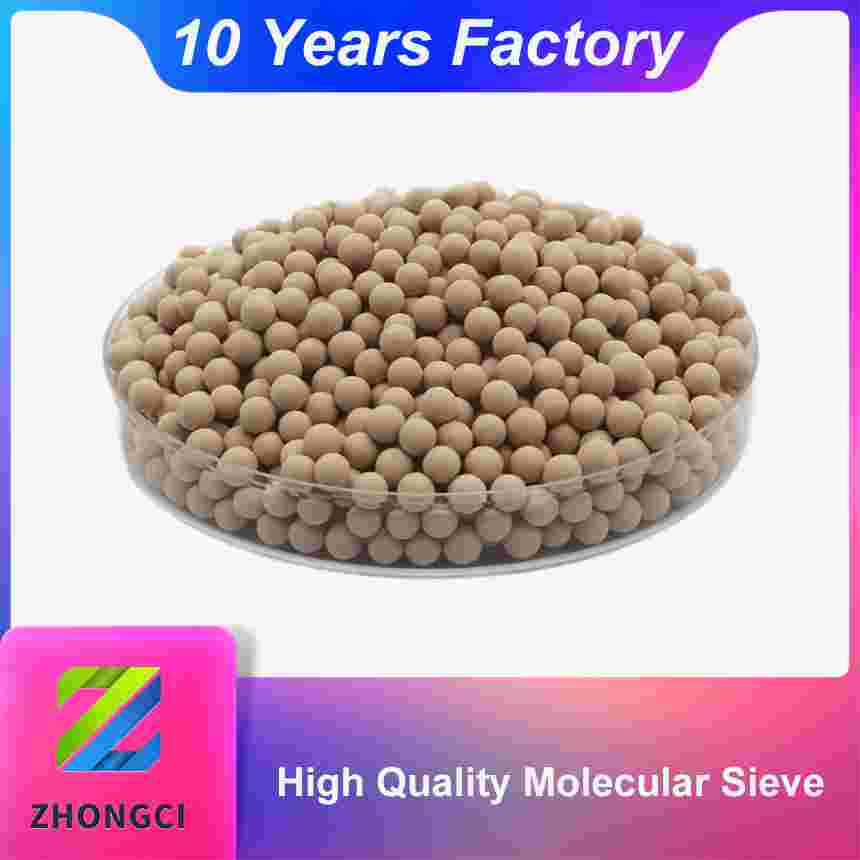
Synthetic zeolite molecular sieves are artificially engineered crystalline aluminosilicate materials with uniform pore structures and high adsorption selectivity. They are widely used in separation, catalysis, and purification due to their tunable chemical composition and pore size.
Structural Characteristics and Synthesis
Chemical Composition and Crystal Structure
Synthetic zeolites typically consist of aluminosilicate frameworks balanced by cations (e.g., Na⁺, K⁺) and water molecules. For example, zeolite T has the formula 0.7-1.5[xNa₂O:(1-x)K₂O]Al₂O₃:6.4-7.4SiO₂:0-8H₂O (x=0.1-0.8) and exhibits a distinct X-ray diffraction pattern. Their porous structure includes interconnected channels and cavities, enabling molecular sieving based on size and polarity.
Synthesis Process
- Precursor Preparation: Mix sodium/potassium aluminosilicate mixtures with specific compositions (e.g., TABS:0912936/III/1 or TABS:0912936/III/2).
- Crystallization: Heat the mixture at 100–150°C until crystals form.
- Activation: Remove water by heating to 300°C under atmospheric/reduced pressure or vacuum at room temperature.

Key Properties and Applications
Adsorption Performance
Activated zeolites preferentially adsorb polar, unsaturated, or straight-chain hydrocarbons. Comparative data shows high adsorption capacities for water, ammonia, thiophene, and n-pentane, while weakly adsorbing nonpolar molecules like argon and iso-butane.
Industrial Applications
- Petroleum Refining: Used for desulfurization (e.g., removing thiophene from coke-oven benzene) and hydrocarbon separation.
- Gas Purification: Hydrophobic zeolites assist in CO₂ control technology.
- Catalysis: Supports for TiO₂ photocatalysts, enhancing reaction efficiency.
Material Modification
Modifications like ion exchange (e.g., Na⁺-K⁺ exchange with a capacity of 189.74 mmol/100g) or loading with metal oxides (e.g., Fe₂O₃ in 13X zeolite) optimize properties such as desorption temperature and catalytic activity.
Conclusion
Synthetic zeolite molecular sieves are versatile materials with tailored structures and functionalities. Their synthesis flexibility and adsorption/catalytic properties make them indispensable in chemical, environmental, and energy sectors, with ongoing research focusing on core-shell composites and advanced synthesis methods like vapor-phase transport.