Overview of PSA Carbon Molecular Sieve
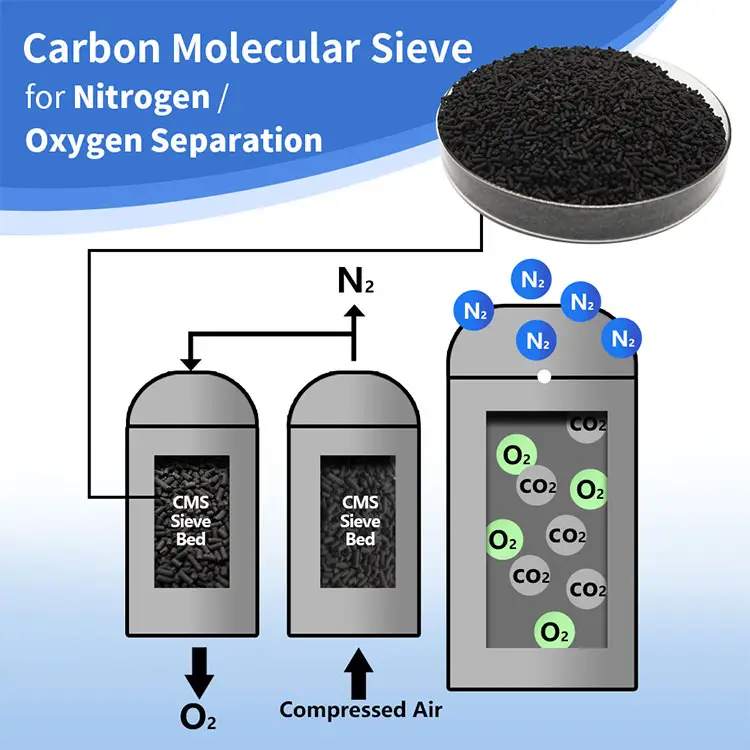
PSA Carbon Molecular Sieve (CMS) is a specialized adsorbent material widely used in gas separation processes, particularly in Pressure Swing Adsorption (PSA) nitrogen plants. It belongs to the category of carbon-based molecular sieves, designed to selectively adsorb certain gas molecules based on their size and polarity. Its primary application is the separation of nitrogen from air, leveraging differences in adsorption rates of oxygen and nitrogen molecules.
Key Properties and Mechanism
- Adsorption Selectivity: CMS exhibits higher adsorption affinity for oxygen compared to nitrogen, allowing efficient separation under pressure cycling conditions.
- Porous Structure: The material features a network of micropores with precisely controlled sizes, enabling size-based exclusion of gas molecules.
- Regenerability: Through pressure swing cycles (adsorption at high pressure, desorption at low pressure), CMS can be repeatedly regenerated for continuous operation.
Industrial Applications
- Nitrogen Production: Dominantly used in PSA nitrogen plants to generate high-purity nitrogen (95-99.999%) for industries such as electronics, chemicals, and petroleum.
- Gas Separation: Also applied in oxygen-argon separation experiments and air drying processes.
- Petrochemical Industry: Utilized as a sorbent in hydrocarbon processing and natural gas purification.
Market and Supply
Major manufacturers, such as Pingxiang Zhongci Environmental Ceramics Material Co., Ltd., offer annual production capacities exceeding 10,000 metric tons. Key export ports include Shanghai and Shenzhen, with product specifications tailored to PSA system requirements. Pricing typically ranges from US500toUS500toUS2,000 per metric ton, depending on purity and performance grade.
Technical Considerations
- Performance Metrics: Critical parameters include adsorption rate (e.g., O₂, N₂, Ar adsorption kinetics) and PSA cycle efficiency.
- Material Characterization: Evaluated through BET surface area analysis, pore size distribution, and mechanical strength testing.
- Compatibility: Must be integrated with system components like ceramic packing and activated alumina for optimal desiccation and separation.