Overview of Nitrogen Molecular Sieve
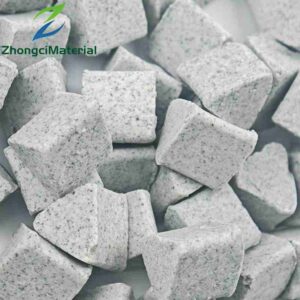
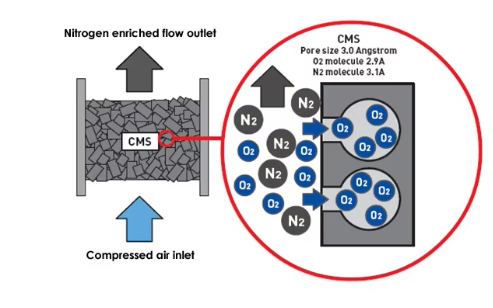
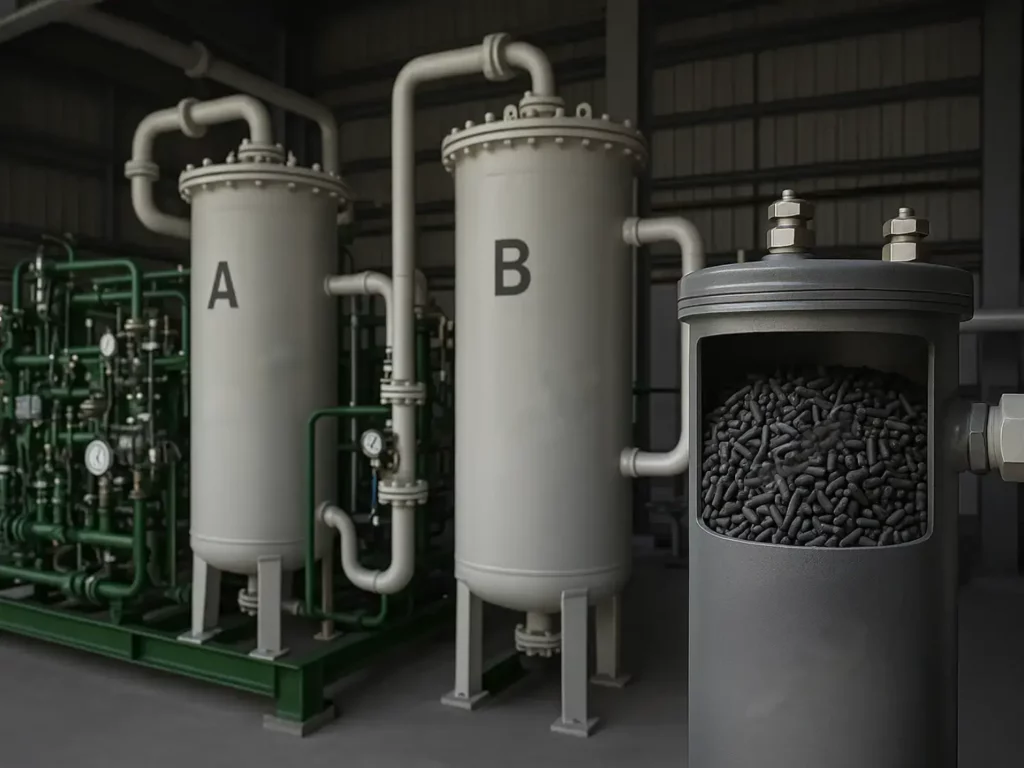
Nitrogen molecular sieve (NMS), particularly carbon molecular sieve (CMS), is a specialized adsorbent material widely utilized in industrial nitrogen production. It operates on the principle of kinetic separation of gases. This is leveraging differences in diffusion rates of oxygen (O₂) and nitrogen (N₂) molecules within its porous structure. At room temperature and pressure, CMS preferentially adsorbs smaller O₂ molecules. While allowing larger N₂ molecules to pass through, enabling efficient nitrogen enrichment from air. This technology forms the core of pressure swing adsorption (PSA) systems, which are integral to nitrogen generation across multiple industries.
Mechanism of Action
The separation efficiency of CMS stems from two key properties:
- Molecular Diffusion: O₂ molecules (kinetic diameter ~0.346 nm) diffuse faster than N₂ (0.364 nm) through CMS pores, leading to preferential adsorption of O₂ under pressure.
- Surface Interaction: The carbonaceous framework of CMS exhibits stronger van der Waals forces with O₂, enhancing its adsorption capacity compared to N₂.
In binary gas mixtures (e.g., air), codiffusion effects can enhance flux rates for both components, while counterdiffusion may reduce separation efficiency, highlighting the importance of optimizing operating conditions like pressure and flow rate.
Applications Across Industries
CMS-based nitrogen production systems are valued for their compact design and on-demand nitrogen supply. Key applications include:
- Chemical & Oil/Gas: Inert gas blanketing for storage tanks and pipeline purging to prevent explosions.
- Electronics: Ultra-pure nitrogen for semiconductor manufacturing to avoid oxidation.
- Food Industry: Packaging and preservation to extend shelf life by displacing oxygen.
- Metal Heat Treatment: Controlled atmosphere furnaces to prevent surface oxidation during annealing.
Recent Technological Advances
Recent research has explored modifications to enhance CMS performance:
- Surface Functionalization: Post-synthesis treatments with silanes (e.g., trimethylchlorosilane) in polar solvents like acetone can tailor pore size distribution and hydrophobicity, improving selectivity for N₂.
- Plasma-Assisted Modification: Exposure to plasma (e.g., N₂/O₂ mixtures) creates surface nitrate groups (NO₃⁻), which may act as active sites for catalytic nitrogen fixation, bridging traditional adsorption with plasma catalysis.
Conclusion
Carbon molecular sieve remains a cornerstone of modern nitrogen production, offering cost-effective and scalable solutions. Ongoing innovations in material modification and integration with advanced processes like plasma catalysis promise to expand its role beyond separation into emerging fields such as sustainable nitrogen fixation and environmental remediation.