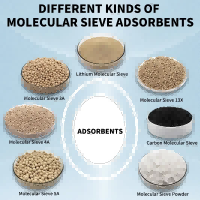
Molecular sieve adsorbents are a type of synthetic zeolite with a unique structure and excellent adsorption properties, playing a crucial role in various industrial fields.
Structure and Composition
Molecular sieves are silicon – aluminum compounds with a cubic lattice structure. They are typically white or grayish – white spherical, granular, bar – shaped, bead – shaped, flaky substances or powders. Their chemical composition represents by the general formula: (Mⁿ⁺)₂/ₙO·Al₂O₃·xSiO₂·pH₂O, where M stands for metal ions (usually Na in artificial synthesis), n is the valence of the metal ion, x is the molar number of SiO₂ (also know as the silica – alumina ratio), and p is the molar number of water.
The basic structure of the molecular sieve framework consists of SiO₄ and AlO₄ tetrahedra, which connect through oxygen bridges to form a three – dimensional network structure. The structure has many uniform – sized channels and well – arranged cavities with a large internal surface area. It also contains metal ions with low valence and large ionic radii and combined water. When heated, the water molecules continuously lost, but the crystal framework structure remains unchanging, creating a large number of cavities of the same size, which connects by micropores of the same diameter.
Adsorption Principle
The key feature of molecular sieves is their ability to “screen” molecules. The tiny pores in molecular sieves have a uniform diameter. They can adsorb molecules smaller than the pore diameter into the cavities, while excluding larger molecules. This selective adsorption is based on the size, shape, polarity, and saturation of the molecules. For example, they can separate molecules with different shapes, polarities, boiling points, and saturation degrees.
Types and Applications
3A Molecular Sieve
The chemical formula of 3A molecular sieve is 2/3K₂O·1/3Na₂O·Al₂O₃·2SiO₂·4.5H₂O. It is mainly for drying unsaturated hydrocarbons such as petroleum cracking gas, ethylene, and butadiene. It is also suitable for drying polar liquids like methanol and ethanol, refrigerants, kerosene, and aviation fuel. Additionally, it can be for drying nitrogen – hydrogen mixed gases and as a desiccant in industries such as petrochemical and vacuum glass.
4A Molecular Sieve
With the chemical formula Na₂O·Al₂O₃·2SiO₂·4.5H₂O, 4A molecular sieve is one of the most widely-used types in industry. It is for deep drying of gases and liquids such as air, natural gas, alkanes, and refrigerants. It can also be for the production and purification of argon, static drying of pharmaceutical packaging, electronic components, and perishable substances, and as a dehydrating agent in paints, dyes, and coatings. It can adsorb normal – paraffins and alcohol gases and has high stability in weak acid media.
5A Molecular Sieve
The chemical formula of 5A molecular sieve is 0.7CaO·0.3Na₂O·Al₂O₃·2SiO₂·4.5H₂O. It has a pore size of 5 Å and can adsorb any molecule smaller than this size. In addition to the functions of 3A and 4A molecular sieves, it can also adsorb C3 – C4 normal – paraffins, chloroethane, bromoethane, and butanol. It is particularly suitable for pressure swing adsorption separation due to its high selective adsorption and fast adsorption rate.
13X Molecular Sieve
13X molecular sieve can adsorb molecules with a larger critical diameter. It is mainly for gas drying and purification, especially for purifying the feed gas in air separation units. It can effectively adsorb carbon dioxide, water, and organic sulfur compounds in the air. It can also be for desulfurization of natural gas and liquefied petroleum gas and as a carrier.
Advantages
Molecular sieve adsorbents have several advantages. They have a high adsorption capacity, especially for water. Even at relatively high temperatures, large space velocities, and low water content, they still have a considerable water – absorption capacity. Their pore size distribution is very uniform, which ensures high selectivity in adsorption. They also have good thermal stability and mechanical strength, making them suitable for long – term use in various industrial processes.
In conclusion, molecular sieve adsorbents are versatile materials with unique adsorption properties, which are widely-used in gas separation, drying, purification, and catalysis in the petrochemical, refrigeration, and other industries. Their application has greatly promoted the development and efficiency improvement of these industries.