In the field of gas separation technology, membrane nitrogen generation and carbon molecular sieve (CMS) nitrogen generation are two common methods. So, this article provides a detailed comparison of their operational principles, efficiency, purity, costs, and applicable scenarios to guide informed decision-making.
Operational Principles
Carbon Molecular Sieve (CMS) Nitrogen Generation
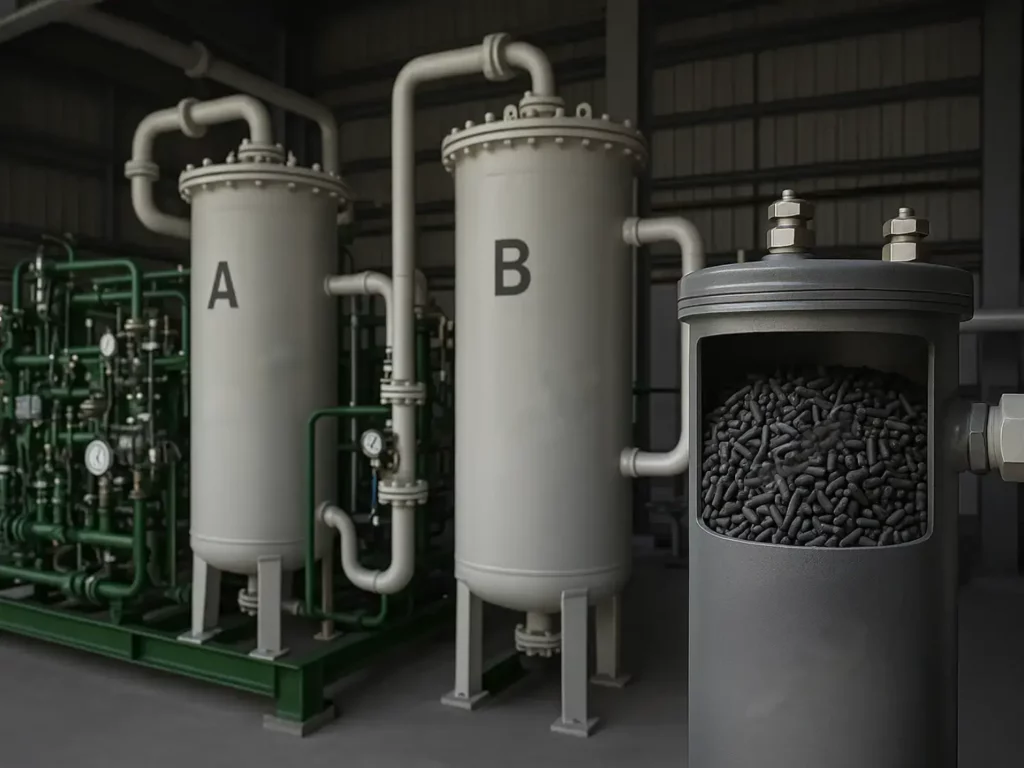
CMS technology relies on adsorption selectivity and pressure swing adsorption (PSA). Carbon molecular sieves have micropores (≈4 Å) that exhibit a stronger affinity for oxygen molecules than nitrogen molecules. When compressed air flows through the CMS bed, oxygen (O₂), carbon dioxide (CO₂), and water vapor (H₂O) adsorbed, while nitrogen (N₂) enriched and exits as the product. Therefore, the process alternates between adsorption (high pressure) and regeneration (low pressure) using dual towers (A and B) to ensure continuous nitrogen production.
Membrane Nitrogen Generation
Membrane technology utilizes differential gas permeability through polymeric membranes. Under pressure, mixed gases (e.g., air) separated base on varying solubility and diffusion rates in the membrane material. “Fast gases” (e.g., O₂, CO₂, H₂O) permeate through the membrane quickly, while “slow gases” (e.g., N₂) retained and concentrated. This passive separation requires no moving parts but depends on membrane stability and selectivity.
Efficiency, Purity, and Performance
Purity and Efficiency of carbon molecular sieve nitrogen generation
- CMS Nitrogen Generation: Delivers high-purity nitrogen (up to 99.999%) due to its exceptional adsorption selectivity for oxygen. The PSA cycle ensures efficient separation, making it ideal for applications demanding ultra-high purity.
- Membrane Nitrogen Generation: Purity limited by membrane material constraints, typically ranging from 95% to 99.9%. Its efficiency influenced by operating pressure, temperature, and membrane aging.
Operational Stability of carbon molecular sieve nitrogen generation
- CMS systems are mature and stable but require periodic regeneration of adsorbents.
- Membrane systems offer continuous operation but may experience performance degradation over time due to membrane fouling.
Cost Analysis and Applicable Scenarios
Cost Comparison
| Aspect | CMS Nitrogen Generation | Membrane Nitrogen Generation |
|————————–|——————————————–|——————————————–|
| Initial Investment | Higher (complex PSA system, dual towers) | Lower (simpler design, no moving parts) |
| Energy Consumption | Higher (pressure cycling requires energy) | Lower (passive membrane separation) |
| Maintenance | Regular (adsorbent replacement every 3,000–4,000 hours) | Minimal (occasional membrane replacement) |
| Footprint | Larger (bulky towers and compressors) | Compact (suitable for limited spaces) |
Application Scenarios
- CMS Technology: Preferred in industries requiring high-purity nitrogen, such as electronics manufacturing, chemical processing, and metal heat treatment.
- Membrane Technology: Ideal for low-to-medium purity needs in mobile applications, on-site oil & gas operations, and food packaging, where portability and cost-efficiency prioritized.
Conclusion
The choice between CMS and membrane nitrogen generation depends on purity requirements, cost constraints, and operational flexibility. CMS excels in high-purity, large-scale industrial settings, while membrane systems offer advantages in compact, low-maintenance, and cost-sensitive applications. Understanding these trade-offs ensures optimal selection for specific industrial needs.