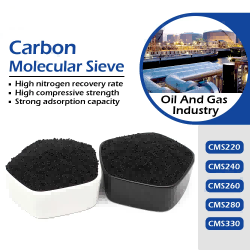
High strength carbon molecular sieves (CMS) are a type of advanced adsorbent material in the 1970s. They are excellent non – polar carbon materials with a series of unique properties and wide – ranging applications.
1. Composition and Structure
Carbon molecular sieves mainly composed of carbon. Their internal structure characterized by a large number of micropores. These micropores have a crucial role in the separation process. For effective separation of oxygen and nitrogen, the internal micropore distribution of carbon molecular sieves should be in the range of 0.28 – 0.38nm. In this range, oxygen molecules can quickly diffuse into the pores, while nitrogen molecules have difficulty passing through the pore openings. However, it should note that the control of pore size is a key factor. If the pore size is too large, both oxygen and nitrogen can easily enter the pores, losing the separation effect; if it is too small, neither can enter. Among the products on the market, only Iwatani molecular sieves can achieve a micropore size distribution of 0.28 – 0.36nm, while domestic molecular sieves generally have a micropore size distribution in the range of 0.3 – 1nm.
2. Manufacturing Process of High strength carbon molecular sieves
The production of high – strength carbon molecular sieves involves several steps. Firstly, raw materials such as coconut shells, coal, and resins processed and pulverized, and then kneaded with a base material. The base material is to increase the strength of the molecular sieve and prevent it from breaking and pulverizing. Secondly, activation and pore – making carried out. At a temperature of 600 – 1000°C, an activator (such as steam, carbon dioxide, oxygen, or their mixtures) introduced. These activators react with the active amorphous carbon atoms through a thermal – chemical reaction to expand the specific surface area and gradually form pores. The activation time ranges from 10 – 60 minutes. Finally, the pore structure adjusted. Chemical vapor, such as benzene vapor, is to deposit on the inner walls of the micropores of the carbon molecular sieve to adjust the pore size to meet the requirements.
3. Separation Principle and Advantages in Nitrogen Production
Carbon molecular sieves achieve the separation of oxygen and nitrogen by taking advantage of the different diffusion rates of gas molecules. In the process of separating air to enrich nitrogen, a normal – temperature and low – pressure nitrogen production process adopted. Compared with the traditional cryogenic high – pressure nitrogen production process, it has many advantages, including lower investment costs, faster nitrogen production speed, and lower nitrogen production costs.
4. Applications
4.1 Gas Separation
One of the most important applications of high – strength carbon molecular sieves is in gas separation. They widely used in the separation of gases such as oxygen, nitrogen, and hydrogen. For example, in the production of high – purity nitrogen, carbon molecular sieves can effectively separate nitrogen from air, which widely used in industries such as chemical engineering, electronics, and food packaging.
4.2 Adsorption
Due to their large surface area and fine pore structure, carbon molecular sieves can effectively adsorb small molecules in gases and liquids. In the field of air purification, they can adsorb harmful gases and odors, improving air quality. In the field of water treatment, they can remove organic matter and heavy metal ions in water, enhancing water quality.
4.3 Catalysis
Carbon molecular sieves can serve as good catalyst carriers. Their high specific surface area and porous structure are beneficial for the adsorption and diffusion of reactants, thereby improving catalytic efficiency. They can also act as catalysts themselves in certain chemical reactions, such as catalytic cracking and alkylation reactions in the petrochemical industry.
5. Market Situation
For a long time, carbon molecular sieves have been monopolized by Japan and Germany. Before 2000, they occupied about 80% of the domestic market and had a dominant position in the international market. However, after the technology was introduced into China by Changxing Chemical Factory, domestic carbon molecular sieve manufacturers, mainly located in Changxing, Shandong, Xuancheng and other places, have gradually seized a large part of the market share. With the continuous development of China’s economy, especially the expansion of the chemical industry, the demand for carbon molecular sieves is increasing year by year. In the future, high – strength carbon molecular sieves will develop towards higher indicators, higher strength, and higher bulk density, and low – grade products will be gradually phased out.
In conclusion, high – strength carbon molecular sieves, with their unique properties and wide – ranging applications, play an important role in modern industry and will continue to show great potential in future development.