1. Definition and Core Function
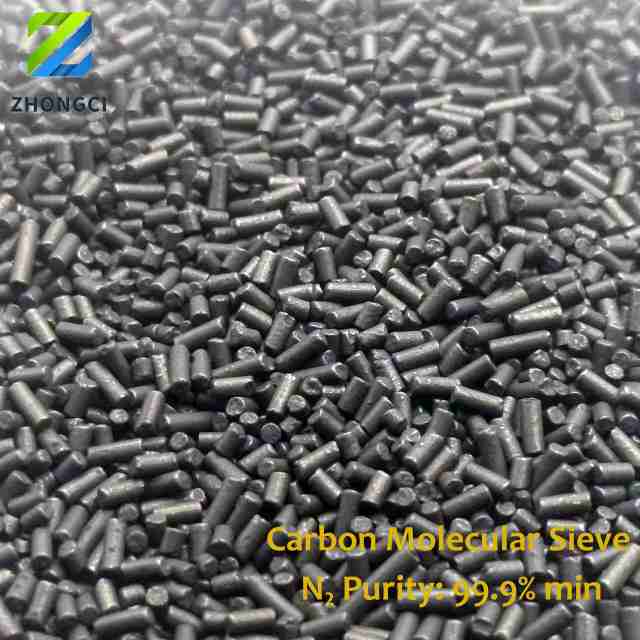
High Purity Carbon Molecular Sieve (HPCMS) is a specialized adsorbent material engineered for the selective separation of gas molecules based on size and kinetic diameter differences. However, unlike conventional adsorbents, HPCMS exhibits exceptional micropore structure control (typically < 2 nm), enabling high-precision separation of gases like N₂/O₂, CO₂/CH₄, and H₂/CO. Its “kinetic selectivity” preferentially adsorbs slower-diffusing molecules (e.g., N₂) while allowing faster gases (e.g., O₂) to pass through—critical for industrial gas purification.
2. Manufacturing Process
HPCMS is synthesized through:
- Carbonization: Pyrolysis of organic precursors (e.g., coconut shells, polymers) under inert conditions.
- Activation: Controlled oxidation (steam/CO₂) to refine pore size distribution.
- Purity Enhancement: Post-treatment (e.g., acid washing, thermal annealing) to reduce ash content and metallic impurities below 0.01%, ensuring adsorption integrity.
- Structural Reinforcement: Incorporating short-cut carbon fibers (length < 2mm) during molding enhances mechanical strength. Then, resisting fragmentation in pressurized systems.
3. Operational Mechanism in PSA Systems
In Pressure Swing Adsorption (PSA) units:
- Adsorption Phase: Compressed air enters columns packed with HPCMS; N₂ is trapped in micropores while high-purity oxygen (>99.5%) flows through .
- Desorption Phase: Pressure reduction releases N₂, regenerating the sieve.
- Cycle Optimization: Precision in adsorption timing (seconds) and exhaust gas management directly impacts O₂ purity and energy efficiency.
4. Key Performance Specifications
- Purity Standards: Complies with stringent regulations (e.g., food-grade CO₂ under GD1917-80 for beverages).
- Stability: Minimal aging over >50,000 cycles due to hydrophobic carbon structure.
- Selectivity Ratios: N₂/O₂ selectivity >10:1, outperforming zeolites in moisture-rich streams.
5. Industrial Applications
- Oxygen Generation: Medical/industrial O₂ plants (purity 93–99.5%).
- CO₂ Purification: Recovery from fermentation or flue gas, achieving >99.9% food/pharma-grade CO₂.
- Biogas Upgrading: Separation of CH₄ from CO₂/H₂S contaminants.
6. Future Developments
Research focuses on functionalized HPCMS (e.g., boron-doped surfaces) to enhance selectivity for hydrogen purification and carbon capture, leveraging advances in molecular engineering.
Conclusion
High Purity Carbon Molecular Sieve represents a pinnacle of adsorption technology, combining tailored porosity, robust mechanics, and ultra-low impurities. Moreover, their role in sustainable gas separation—from medical oxygen to carbon capture—aligns with global decarbonization goals. Ongoing innovations promise broader applicability in hydrogen economy and circular carbon systems.