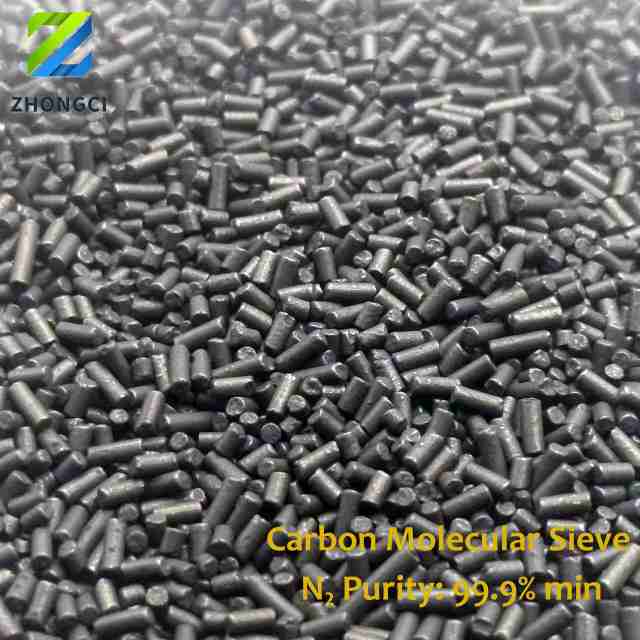
Carbon molecular sieve (CMS) membranes represent a cutting-edge class of inorganic membranes. It is renowned for their exceptional performance in gas separation processes. Among the various CMS variants, CMS 350 stands out as a prominent material. Leveraging advanced porous structure engineering to achieve high selectivity and permeability for target gas molecules. While specific details of CMS 350 are not explicitly referenced in the provided sources. Its design is rooted in the core principles of CMS technology. This emphasizes precise control over pore size distribution and surface chemistry to optimize separation efficiency.
Key Properties and Separation Mechanisms
CMS 350 exhibits several critical properties that underpin its effectiveness in industrial applications
- Porous Architecture: The material features a well-defined network of micropores and ultramicropores, tailored to discriminate between gas molecules based on size and adsorption affinity. This structure is analogous to CMS membranes fabricated with porous organic cage (POC) fillers, which enhance porosity and narrow pore size distribution.
- Gas Separation Performance: CMS 350 is engineered for high perm-selectivity, a trait shared with state-of-the-art CMS membranes that have demonstrated superior CO₂/CH₄ separation efficiency (e.g., 2002 Barrer CO₂ permeability and 221.6 CO₂/CH₄ selectivity). Its performance likely exceeds industry benchmarks, such as the 2019 Robeson upper bound for gas pairs.
- Thermal and Chemical Stability: Inheriting the robust nature of CMS materials, CMS 350 maintains structural integrity under harsh operating conditions, including high temperatures and exposure to corrosive gases.
The separation mechanism of CMS 350 involves two primary processes:
- Adsorption-Diffusion Kinetics: Gases diffuse through the CMS matrix via activated diffusion. Where smaller or more strongly adsorbed molecules (e.g., CO₂) permeate faster than larger or weakly adsorbed ones (e.g., CH₄). This process is often modeled using dual diffusion resistance theory.
- Size Exclusion: The ultramicroporous structure (<0.7 nm) selectively allows smaller molecules to pass while blocking larger ones, a principle utilized in air separation for O₂/N₂ separation.
Applications and Industrial Relevance
CMS 350 finds utility in diverse industrial scenarios, building on the versatile applications of CMS technology:
- Natural Gas Purification: It effectively separates CO₂ from CH₄ in natural gas streams, mitigating pipeline corrosion and enhancing fuel quality.
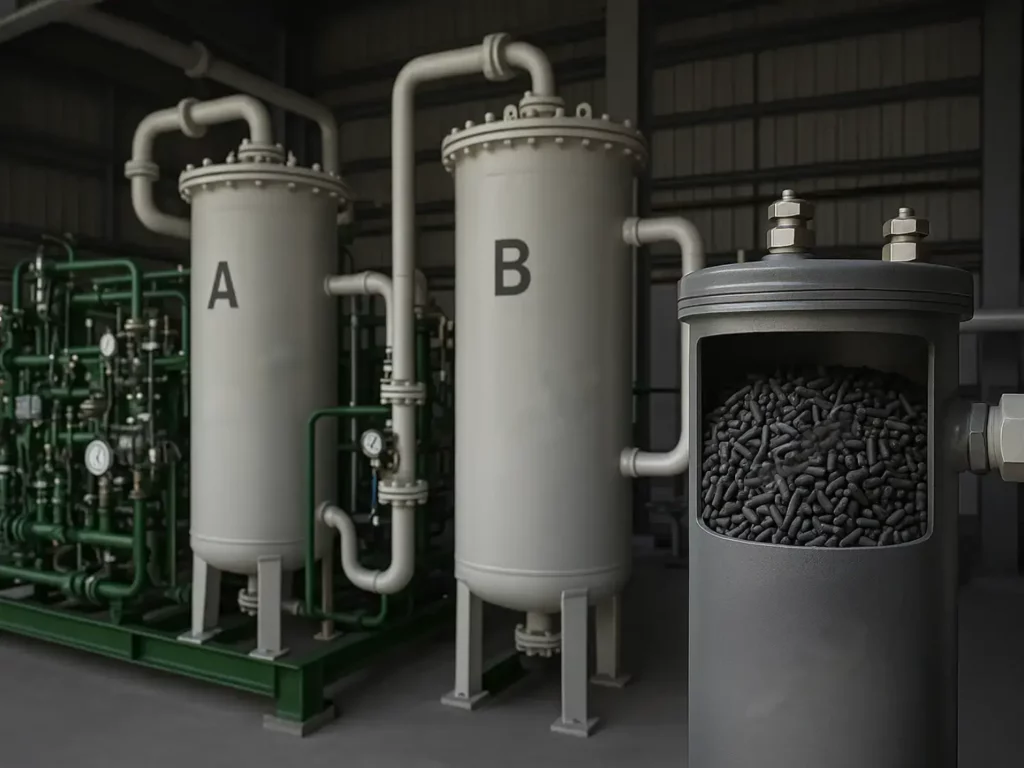
- Air Separation: CMS 350 can be integrated into pressure swing adsorption (PSA) systems for O₂/N₂ separation. Its similar to coal-based CMS materials valued for their low cost and abundant raw material sources.
- Noble Gas Separation: Leveraging distinct adsorption properties, it may facilitate radon-xenon separation. A capability demonstrated by CMS materials in analytical and nuclear applications.
- Hydrogen Recovery: Aligned with CMS membranes’ potential in H₂ separation, CMS 350 could aid in purifying hydrogen from industrial off-gases, supporting clean energy initiatives.
Advantages Over Conventional Materials
Compared to traditional separation media like activated charcoal or polymeric membranes, CMS 350 offers several advantages:
- Higher Selectivity: Narrower pore size distribution minimizes non-selective permeation, outperforming many polymeric membranes.
- Long-Term Stability: Resistant to aging and plasticization, ensuring consistent performance over extended operation periods, as observed in POC-enhanced CMS membranes with >30 days of durability.
- Energy Efficiency: By enabling high-flux, low-energy separation, CMS 350 reduces operational costs compared to energy-intensive processes like cryogenic distillation.
Conclusion
CMS 350 carbon molecular sieve exemplifies the evolution of carbon molecular sieve technology, combining precision-engineered porosity with robust material properties to meet the demands of modern gas separation challenges. While specific data on CMS 350 carbon molecular sieve is not provided in the references, its design aligns with advancements in CMS research—such as the use of novel precursors and fillers—to push the boundaries of separation performance. As industries pursue greener and more efficient processes, CMS 350 is poised to play a pivotal role in applications ranging from natural gas upgrading to carbon capture, offering a sustainable alternative to conventional separation methods.