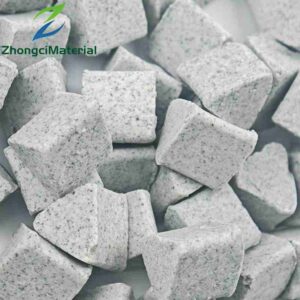
Ceramic random packing are widely used in various industrial fields due to their excellent properties.
I. Chemical and Physical Properties
Ceramic random packing have outstanding acid – and heat – resistance. They can resist the corrosion of various acids and alkalis, except for fluoro – oxygen acid. In high – temperature firing processes. Moreover, they gain excellent mechanical strength, wear – resistance, and the ability to withstand corrosion from inorganic acids (excluding hydrofluoric acid), organic acids, and organic solvents. Thus, this allows them to use in a wide range of temperature conditions, from low to high temperatures.
II. Types and Structures
There are more than forty types of ceramic random packings, including Tri – Y rings, Raschig rings, Cross – partition rings, Pall rings, Intalox saddles, Berl saddles, Conjugate rings, and Flat rings.
- Raschig rings: They are the earliest developed type. Their shape is simple, with the height equal to the diameter. Large – sized Raschig rings (above 100mm) are fill regularly by the whole – brick method, while those below 75mm are generally filled randomly.
- Pall rings: Developed on the basis of Raschig rings, they are high – diameter equal open – ring type packings. Each layer of window holes has 5 tongue – leaves, each bending inwards towards the ring center. The window holes of two adjacent layers stagger. The opening area accounts for about 30% of the total ring – wall area, enabling free passage of gas and liquid through the window holes and improving gas – liquid distribution.
- Intalox saddles: They are open – type packings with a semi – circular groove structure. This structure reduces mutual shielding between packings, increases porosity, improves the effective utilization rate of the mass – transfer surface, and has good fluid – distribution performance. They mainly use in the petrochemical industry and environmental fields such as RTO devices.
- Berl saddles: An improved version of Intalox saddles, they have low pressure drop and high mass – transfer efficiency, and widely use in sulfuric acid drying towers and other tower equipment.
- Cross – partition rings: They are only suitable for regular stacking and generally as the support and distribution layer at the bottom of randomly – packed towers. Cross – partition rings with a specification of Ф80 – 150mm can use as support materials, with a porosity greater than 60%.
III. Applications
Ceramic random packings apply in many industries. They can use as linings in scrubbers, cooling towers, recovery and regeneration towers, desulfurization towers, drying towers, absorption towers, and reactors in industries such as chemical engineering, metallurgy, acid – making, coal gas, oxygen – making, steel, pharmaceuticals, and fine chemicals. They play a crucial role in increasing the contact area between gas and liquid, promoting their intense mixing and mass – transfer processes.
IV. Technical Standards
The production of ceramic random packings follows the Chinese chemical industry standard GB/T18749 – 2002 “Technical Conditions for Chemical – Resistant Ceramic Tower Packings”.
In conclusion, ceramic random packings are essential industrial materials with unique performance characteristics and wide – ranging applications, and they contribute significantly to the development of multiple industries.