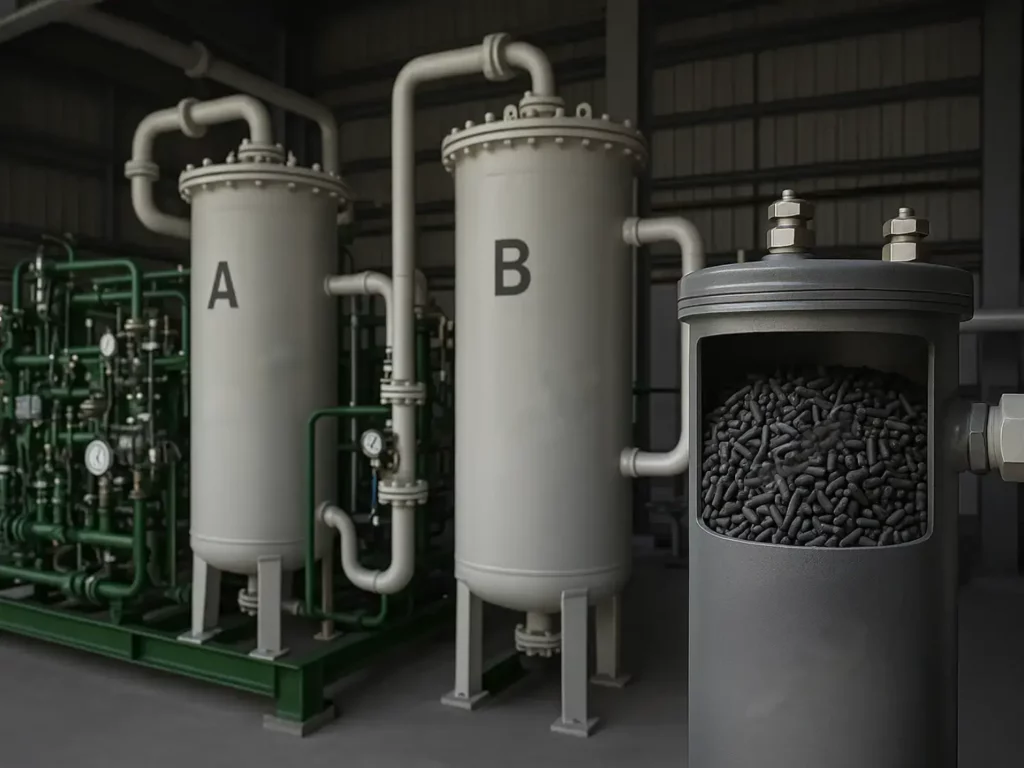
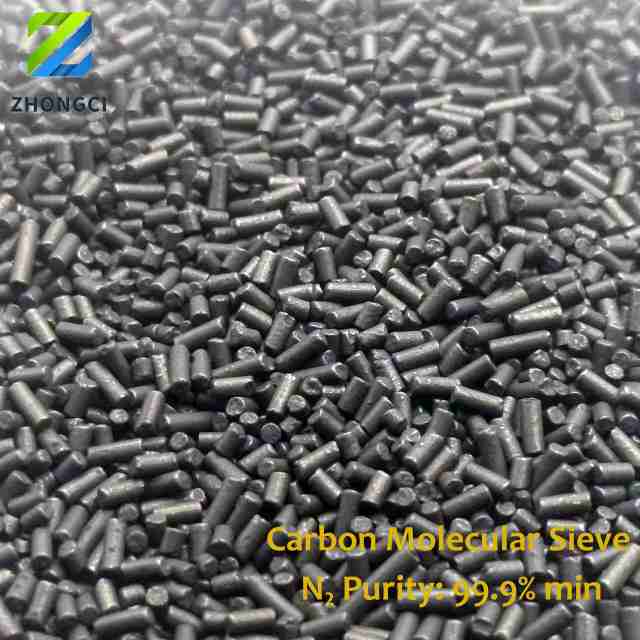
Carbon Molecular Sieve (CMS) is a advanced non-polar carbonaceous adsorbent developed in the 1970s, primarily utilized for separating nitrogen from air through Pressure Swing Adsorption (PSA) technology. Its specifications are critical for determining performance in gas separation, catalytic reactions, and purification processes. Below is a detailed overview of key specifications and their implications.
Core Technical Carbon Molecular Sieve Specifications
1. Pore Structure and Size Distribution
- Pore Size Range: The most critical specification for nitrogen-oxygen separation is a micropore diameter of 0.28–0.38 nm. This range allows rapid diffusion of smaller oxygen molecules (kinetic diameter ~0.346 nm) while restricting larger nitrogen molecules (~0.364 nm).
- Pore Volume & Surface Area: High specific surface area (typically >800 m²/g) and micropore volume enhance adsorption capacity. For example, CMS with uniform 0.3–1 nm pores (e.g., CMS-type) exhibits optimal air separation efficiency.
2. Nitrogen Production Performance
- Nitrogen Yield: Expressed as NM³/h·t (normal cubic meters per hour per ton). Advanced CMS achieves 220–260 NM³/h·t, surpassing traditional German and Japanese products (185 NM³/h·t).
- Nitrogen Recovery Rate: Indicates efficiency in converting air to nitrogen. Higher recovery rates (>90%) reduce energy consumption for PSA systems.
3. Mechanical and Physical Properties
- Bulk Density: Ranges from 0.6–0.8 g/cm³. Higher density improves packing efficiency in adsorber.
- Compressive Strength: Critical for durability; values >100 N/cm² prevent particle fragmentation during cyclic PSA operation.
4. Chemical and Thermal Stability
- Operating Temperature: Stable under PSA conditions (ambient temperature, 600–1000°C during activation).
- Chemical Inertness: Resistant to acids, alkalis, and organic solvents, ensuring long-term performance in harsh environments.
Classification by Application and Pore Size
CMS is categorized into models based on pore structure and use cases:
| Model | Pore Size | Key Application |
|---|---|---|
| CMS | 0.3–1 nm | Air separation (N₂/O₂), methane purification |
| CMK | 2–5 nm | Oil separation, catalytic reactions |
| CMM | 1–2 nm | CO₂/H₂ separation |
| CMO | 0.3–1 nm | Organic pollutant treatment (with oxygen-functional groups) |
Industry Standards and Quality Control
- International Benchmarks: German BF and Japanese Takeda products historically set standards (e.g., 185 NM³/h·t yield), but Chinese CMS now leads with 220–260 NM³/h·t.
- Cost Efficiency: CMS accounts for >70% of PSA system costs, driving demand for high-performance, low-cost alternatives.
Conclusion
Carbon Molecular Sieve specifications—encompassing pore structure, nitrogen yield, mechanical strength, and stability—directly impact its effectiveness in industrial applications. With advancements in activation and pore regulation technologies, modern CMS continues to evolve toward higher efficiency, durability, and cost-effectiveness, solidifying its role in global gas separation markets.