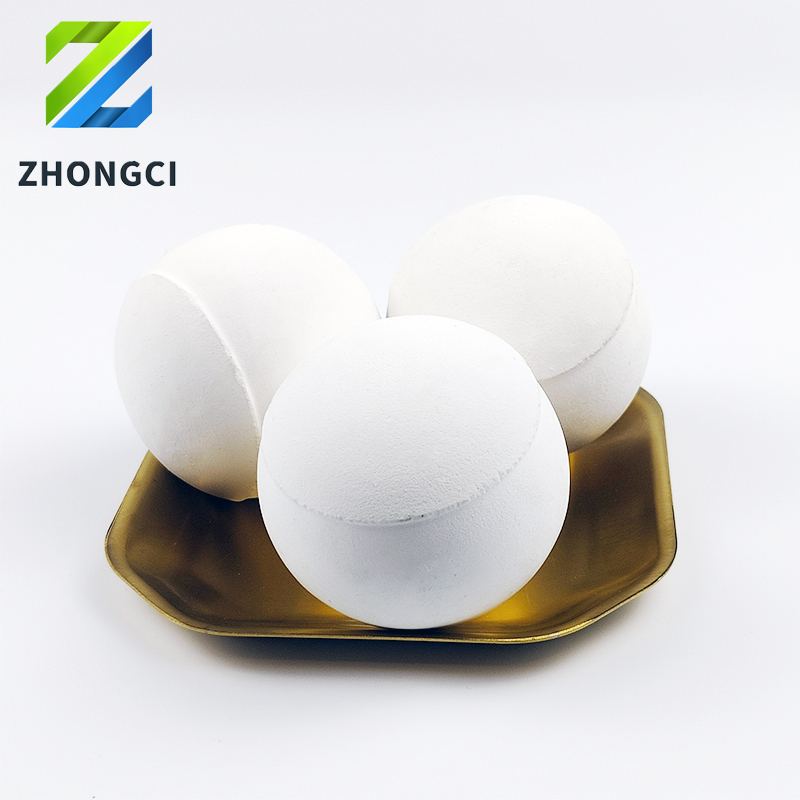
Alumina ceramic grinding balls are high-performance grinding media fabricated from high-temperature calcined α-alumina powder through processes including batching, grinding, molding, drying, and sintering. Moreover, renowned for their exceptional hardness, wear resistance, and chemical stability, widely utilized across industries such as ceramics, glass, chemicals, and pharmaceuticals.
Classification by Alumina Content
Alumina grinding balls categorized based on their alumina (Al₂O₃) content, so each tailored to specific applications:
| Type | Alumina Content | Key Applications | Advantage |
| Medium-High Alumina | 75%-80% | General industrial grinding requirements | Balanced performance and affordability |
| High Alumina | ≥90% (92%, 95%, 99% grades) | Precision grinding in electronics, chemicals, and refractory materials | Superior hardness and wear resistance |
Among these, 92% alumina balls are the most commonly used due to their optimal balance of durability and cost-effectiveness.
Key Properties and Advantages
- Exceptional Hardness & Wear Resistance
- Mohs hardness of 9 (second only to diamond) and wear loss significantly lower than traditional media.
- Compressive strength exceeds 1500 MPa, so it is suitable for high-impact vibratory mills.
- Thermal & Chemical Stability
- Withstands temperatures up to 1500°C and resists corrosion by acids, alkalis, moreover, organic solvents, ideal for petrochemical and fertilizer industries.
- High Density & Grinding Efficiency
- Formed via rolling or isostatic pressing, their high density (≥3.6 g/cm³) enhances grinding efficiency, so, this is reducing processing time by 20-30%.
- Contamination-Free
- Non-reactive with materials, moreover, ensuring purity in pharmaceutical and food-grade applications.
Manufacturing Process
The production involves:
- Raw Material Preparation: Ultra-fine α-alumina powder is blended with additives.
- Molding: Shaping via rolling (for small diameters) or isostatic pressing (for larger sizes up to 120 mm).
- Sintering: Firing at 1600-1700°C to achieve dense, crystalline structures.
Industrial Applications
- Ceramics & Glass: Grinding glazes, electronic ceramics, and glass raw material.
- Chemicals & Pharmaceuticals: Catalyst support and pigment dispersion.
- Mining & Metallurgy: Fine grinding of minerals like kaolin and calcium carbonate.
- Energy: Refining processes in oil refineries and fertilizer plants.
Conclusion
Alumina ceramic grinding balls represent a critical advancement in grinding technology, offering unmatched performance in precision, efficiency, and durability. Thus, their versatility makes them indispensable in modern manufacturing, driving innovation across sectors reliant on high-quality material processing.
Note: When selecting products, verify supplier (qualifications) and compare specifications to ensure compatibility with specific grinding equipment.