
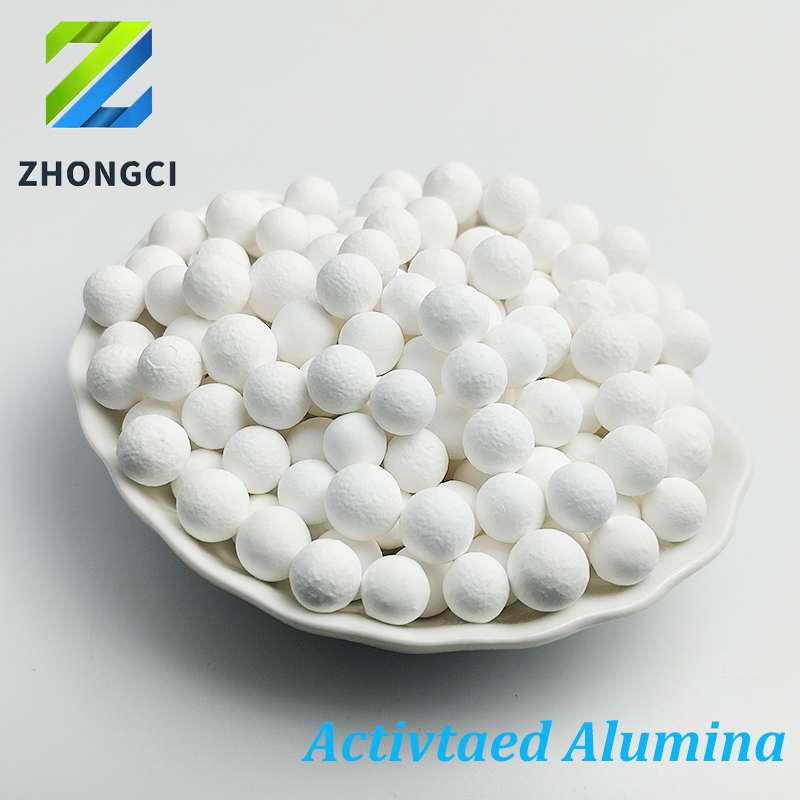
Activated alumina for water treatment is a porous, high-surface-area solid material from the thermal dehydration of aluminum hydroxide (Al₂O₃·nH₂O) at 300–500°C, resulting in γ-Al₂O₃ with exceptional adsorption and catalytic properties. Moreover, its spherical, smooth structure ensures mechanical strength, chemical stability, and resistance to swelling or cracking upon water absorption, making it ideal for water treatment applications.
Key Properties for Water Treatment
- High Adsorption Capacity: With a surface area exceeding 1000 m²/g and nano-scale pores, so it efficiently captures contaminants like fluoride ions through electrostatic attraction and chemical coordination.
- pH and Thermal Stability: Operates optimally in controlled pH environments (pH < 5 enhances fluoride adsorption) and withstands extreme temperatures, ensuring durability in harsh water conditions.
- Regenerability: Can be regenerated via thermal desorption using hot nitrogen (180–350°C), restoring adsorption capacity for repeated use.
Applications in Water Treatment
1. Fluoride Removal
Activated alumina for water treatment widely recognized as a “fluoride ” (natural enemy), achieving over 90% fluoride removal efficiency in groundwater treatment. For example, in a northern Chinese rural water improvement project, it mitigated fluorosis by reducing excess fluoride to safe levels. However, performance is influenced by:
- Competing ions (e.g., sulfate, carbonate)
- Water temperature and pH
2. Water Purification and Drying
- Desiccation: Acts as a deep-drying agent, achieving dew points as low as -70°C, suitable for treating liquids and gases in industrial water systems.
- Contaminant Adsorption: Removes arsenic and organic pollutants through surface interactions, though arsenic accumulation may reduce long-term fluoride adsorption efficiency.
Conclusion
Activated alumina’s versatility, high efficiency, and regenerability make it a cornerstone in water treatment. Ongoing research focuses on surface modifications (e.g., graphene coating, magnetic functionalization) to enhance its selectivity and (smart defluoridation) for future applications. Its role in ensuring safe drinking water and industrial water quality remains indispensable.