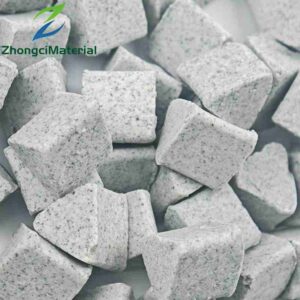
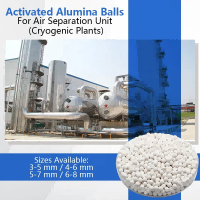
Activated alumina ball adsorbent is a porous, highly dispersed solid material with a large specific surface area, which has good adsorption performance, catalytic activity, high mechanical strength, and chemical stability. Its appearance is white spherical particles with many capillary channels on the surface, and these channels have high activity, enabling selective adsorption of moisture in gases, vapors, and liquids. It is odorless, non-toxic, insoluble in water and alcohol, and does not soften, expand, crack, or powder when immersed in water.
Characteristics of Activated Alumina Ball Adsorbent
- High Adsorption Capacity: It has a strong ability to adsorb water, and the drying depth can reach a dew point below -70 under certain operating conditions. For fluoride adsorption, the capacity is stable, with each cubic meter of activated alumina capable of absorbing 6400 grams of fluorine.
- Excellent Physical Properties: It has high strength, low wear, good thermal stability, and can maintain its original shape and performance even after repeated adsorption and regeneration.
- Good Regenerability: After adsorption saturation, it regenerated by heating at about 175 – 315°C to remove water, and the adsorption and regeneration processes carried out multiple times.
Applications of Activated Alumina Ball Adsorbent
- Gas and Liquid Drying: Widely used in the deep drying of petrochemical gas and liquid phases, such as petroleum cracking gas, ethylene and propylene gas, as well as in the drying of textile industry, oxygen production industry, and automatic instrument air. It is also suitable for the drying of hydrogen production and air separation units.
- Water Treatment: It used for defluoridation, dearsenification of drinking water and industrial water, as well as sewage decolorization and deodorization. It has a strong selective adsorption capacity for fluoride ions in water.
- Catalyst and Catalyst Carrier: Due to its porous structure and large specific surface area, it widely used as a catalyst and catalyst carrier in the petroleum chemical and fertilizer industries.
- Waste Gas Treatment: It can remove pollutants such as hydrogen sulfide, sulfur dioxide, hydrogen fluoride, and hydrocarbons in exhaust gas.
Regeneration Method of Activated Alumina Ball Adsorbent
In drying applications, activated alumina usually regenerated by heating, and hot nitrogen is often used for purging regeneration. This is because water interacts strongly with activated alumina, and it is difficult to completely desorb the adsorbed water by other methods. The process includes three steps: heating, washing, and cooling. The higher the heating temperature, the better the desorption regeneration effect. However, since high – concentration water vapor at high temperatures can seriously damage the structure of activated alumina, it is necessary to purge the activated alumina bed with nitrogen, air, product gas, or other suitable gases during heating. The regenerated activated alumina bed can be for adsorption only after cooling. When using activated alumina to dry liquids such as propylene, the liquid in the activated alumina bed drained without any dead ends during regeneration .