Nitrogen- generating Carbon Molecular Sieves (CMS) are a revolutionary development in the field of gas separation technology. They are a type of non-polar carbon adsorbent material that has been widely used for separating nitrogen from air due to their unique properties and high energy efficiency.
1. Definition and Basic Properties Nitrogen-Generating Carbon Molecular Sieves
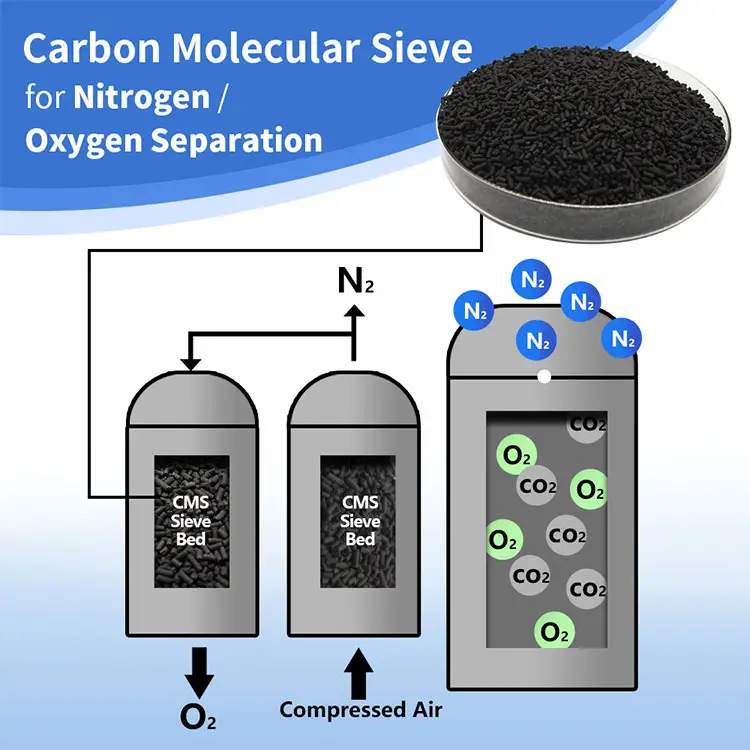
Carbon Molecular Sieves are a new type of adsorbent developed in the 1970s. They are excellent non – polar carbon materials with a large number of micropores. The core component of CMS is elemental carbon, and they appear as black cylindrical solids. These micropores, with a diameter of about 4 Å, have a strong instantaneous affinity for oxygen molecules, which is the key to their ability to separate oxygen and nitrogen from air.
2. Working Principle of Nitrogen-Generating Carbon Molecular Sieves
The separation of air by carbon molecular sieves is based on the different diffusion rates of various gases in its micropores. When compressed air enters the adsorption tower filled with carbon molecular sieves, oxygen, carbon dioxide, and water vapor preferentially adsorbed because their molecular diameters are relatively small and they can diffuse more quickly into the micropores of the carbon molecular sieves. In contrast, nitrogen molecules, with a relatively larger diameter and slower diffusion rate, are less likely to enter the micropores. As a result, nitrogen enriched in the gas phase and flows out from the outlet of the adsorption tower, achieving the separation of nitrogen from air.
This process operates under normal temperature and low pressure conditions, which is a significant advantage compare to traditional cryogenic high – pressure nitrogen production processes. The adsorption and desorption processes alternate, allowing the carbon molecular sieves to regenerate and continuously produce high – purity nitrogen. During the desorption process, the adsorbed oxygen released by simply reducing the pressure, and the carbon molecular sieves regain their adsorption capacity.
3. High – Energy – Saving Advantages
3.1 Low Investment Cost
Compared with the traditional cryogenic high – pressure nitrogen production process, the high – energy – saving nitrogen – generating carbon molecular sieves require less investment. The equipment for the cryogenic process is complex and expensive, including large – scale refrigeration equipment and high – pressure vessels. In contrast, the equipment using carbon molecular sieves is relatively simple and does not require high – cost refrigeration and high – pressure systems, which greatly reduces the initial investment cost.
3.2 Fast Nitrogen Production
The carbon molecular sieve nitrogen production process can quickly produce nitrogen. Under normal temperature and low – pressure conditions, the adsorption and desorption processes are rapid, enabling the equipment to reach the required nitrogen production capacity in a short time. In contrast, the traditional cryogenic process requires a long start – up time to reach the appropriate low – temperature conditions for nitrogen separation, resulting in slower nitrogen production.
3.3 Low Nitrogen Cost
The operation cost of carbon molecular sieve nitrogen production is relatively low. Since it operates at normal temperature and low pressure, it consumes less energy than the cryogenic process. Additionally, the carbon molecular sieves have a long service life and low maintenance cost, which further reduces the overall cost of nitrogen production.
4. Application Fields of Nitrogen-Generating Carbon Molecular Sieves
The nitrogen produced by high – energy – saving nitrogen – generating carbon molecular sieves has a wide range of applications in various industries:
4.1 Chemical Industry
In the chemical industry, high – purity nitrogen used for processes such as ammonia synthesis and the preparation of nitrogen fertilizers. Nitrogen can also be as a protective gas in chemical reactions to prevent oxidation and other side reactions.
4.2 Petroleum and Natural Gas Industry
In the petroleum and natural gas industry, nitrogen is as a protective gas to prevent the explosion of oil and gas wells. It can also be for enhanced oil recovery by injecting nitrogen into the reservoir to increase the pressure and improve oil production efficiency.
4.3 Electronic Industry
In the electronic industry, nitrogen is to protect electronic components from oxidation and damage during the manufacturing and storage processes. It can also be in the semiconductor manufacturing process to create an inert atmosphere.
4.4 Food Industry
In the food industry, nitrogen is used for food packaging to replace oxygen and prevent food from oxidation, spoilage, and the growth of microorganisms, thereby extending the shelf life of food.
4.5 Other Industries
Carbon molecular sieve – generated nitrogen also has applications in the coal industry, pharmaceutical industry, cable industry, metal heat treatment, transportation, and storage fields.
In conclusion, high – energy – saving nitrogen – generating carbon molecular sieves, with their unique separation principle, high – energy – saving advantages, and wide range of applications, have become an indispensable element in modern industry.