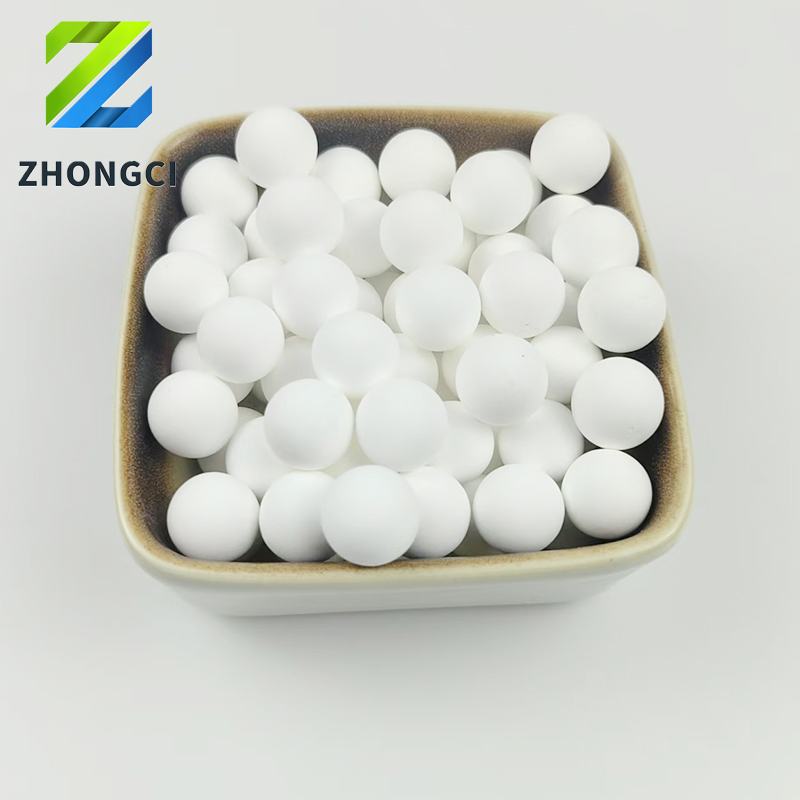
High alumina packing balls, also known as high alumina ceramic balls, spherical objects made primarily of aluminum oxide (Al2O3). These balls designed for use in various industrial applications, particularly in the chemical and petrochemical industries, where they serve as packing materials in columns and reactors.
Advantages
High alumina packing balls offer several advantages over other types of packing materials. They have excellent thermal stability, allowing them to withstand high temperatures without deforming or breaking. Additionally, they have good chemical resistance, making them suitable for use in corrosive environments. The balls also provide efficient mass transfer and good flow distribution within the column, which contributes to improved process efficiency and productivity.
Manufacturing process of high alumina packing balls
The manufacturing process for high alumina packing ball typically involves sintering a mixture of raw materials, including aluminum oxide, at high temperatures. This process results in a dense, homogeneous material with uniform properties throughout the sphere. The balls produced in various sizes and shapes to meet specific application requirements.
Electrical Insulation: High alumina packing ball can be used as electrical insulators in high-voltage applications, thanks to their excellent dielectric strength and resistance to electrical breakdown.
Precision Engineering: In precision engineering applications, such as bearings and bushings, high alumina packing balls offer low friction, wear resistance, and dimensional stability, ensuring smooth operation and long service life.
In summary, high alumina packing ball are an essential component in many industrial processes, offering superior performance in terms of thermal stability, chemical resistance, and mass transfer efficiency.