As an important industrial material, perforated ceramic balls are widely use in chemical, petroleum, metallurgical and other fields. A series of standards have established to ensure its performance and quality. Below, we will provide a detailed introduction to the standards and applications of perforated ceramic balls.
1、 Definition and classification of perforated ceramic ball
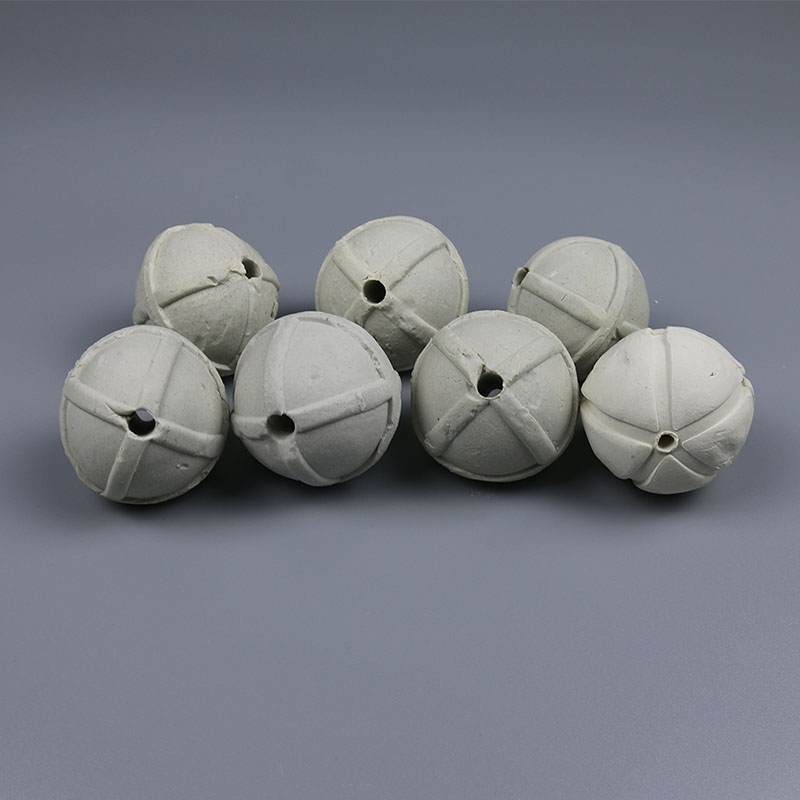
Perforated ceramic ball, as the name suggests, is a type of ceramic ball with holes on its surface. According to the size, shape, and distribution of the holes, perforated ceramic ball can divide into various types, such as microporous ceramic balls, macroporous ceramic balls, etc. Different types of perforated ceramic ball have different performance characteristics and are suitable for different application scenarios.
2、 Technical specifications of perforated ceramic ball
- Aperture and porosity: Aperture refers to the size of the holes on the surface of the perforated ceramic ball, while porosity refers to the proportion of the area occupied by the holes. These two indicators directly affect the breathability and filtration effect of perforated ceramic ball. Generally speaking, the smaller the aperture and the higher the porosity, the better the breathability and filtration effect of perforated ceramic ball.
- Compressive strength: Compressive strength is an important indicator for measuring the compressive capacity of perforated ceramic ball. High quality perforated ceramic ball should have high compressive strength to ensure that they uneasily broken or deformed during use.
- Corrosion resistance: As perforated ceramic balls are often use in corrosive environments, corrosion resistance is also one of their important technical indicators. High quality perforated ceramic ball should be able to resist various chemical corrosion and maintain stable performance.