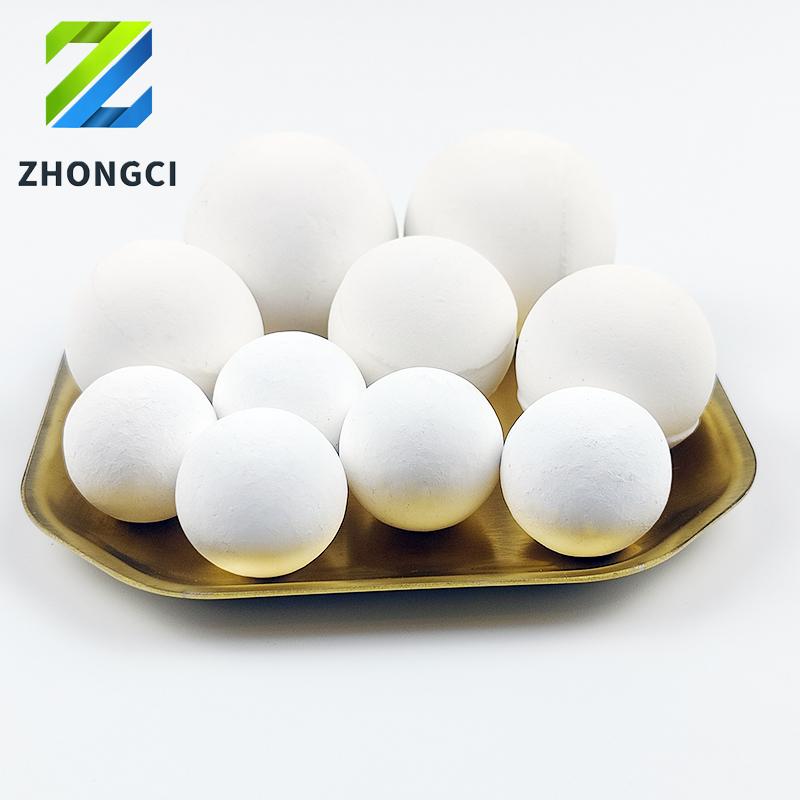
As a high-performance grinding medium, alumina ceramic grinding balls have unique characteristics mainly due to the synergistic effect of material composition, forming process, and firing technology, manifested in the following multidimensional advantages
Dual breakthrough in materials and performance
Ultra high purity and chemical inertness: mainly composed of high-purity alumina such as 92% and 95%, with high whiteness and stable chemical properties. Except for strong corrosive media such as hydrofluoric acid and concentrated nitric acid, it does not react with acids and bases, which can avoid pollution to grinding materials, especially suitable for processing high-purity materials (such as high white quartz and lithium battery materials).
The ultimate performance of hardness and wear resistance: the Mohs hardness is as high as 9 (second only to diamond), the Rockwell hardness is HRA80-90, the wear resistance is 266 times that of manganese steel, the wear is as low as 0.4-0.8 per ten thousand (dry grinding conditions), and the service life is more than 10 times longer than that of steel media, significantly reducing media loss during the grinding process.
High density and structural stability: Through isostatic pressing or rolling forming processes, the density can reach 3.60-3.65g/cm ³, with a large body density and regular shape, improving grinding efficiency while exhibiting excellent anti fragmentation performance under impact loads such as dry grinding.
Advantages of adaptability between process and application
Differentiated design of molding process: Customized molding methods adopted for different diameter requirements. 0.5-25mm small balls mostly rolled, while 20-90mm large balls produced by pressing to ensure the density and dimensional accuracy of the balls, suitable for various scenarios from laboratory trials to industrial scale production.
Extreme environmental tolerance: It can withstand high temperatures above 1000 ℃ and has acid, alkali, and corrosion resistance characteristics. It is suitable for various processes such as wet grinding (such as two-stage water grinding) and dry grinding (such as deep processing of cement and ore), while meeting the demanding working conditions of chemical, metallurgical, and other fields.
The comprehensive benefits of economy and efficiency
Significant improvement in grinding efficiency: Compared to traditional natural or steel balls, the grinding time shortened by 15% -30%. When completely replacing natural balls, the output tripled. By reducing energy consumption (such as electricity bills), the cost difference recovered within 2 years.
Dual protection of equipment and materials: low wear characteristics reduce wear on the inner lining of the ball mill, circular and regular appearance reduces equipment operating noise, while avoiding metal ion pollution, improving the purity and quality stability of downstream products (such as ceramic glazes and electronic materials).
The synergistic characteristics of functionality and environmental protection
Low pollution and easy classification management: The white appearance is easy to separate from materials, with a water absorption rate of only 0.01%. It does not adsorb impurities in grinding media, especially suitable for high-end fields such as lithium battery materials and IC chip packaging that are sensitive to iron ions.
Multi functional adaptability: It used as a grinding medium for fine grinding in the ceramic, glass, and chemical industries, as well as a catalyst support material or tower packing, expanding its application scenarios in environmental protection, petrochemicals, and other fields.
Summary: Deep integration of technological characteristics and industrial value
The alumina ceramic grinding balls solve the pain points of traditional grinding media in terms of efficiency, pollution, and lifespan through the core characteristic combination of “high purity high hardness high density low wear”. Its unique advantages are not only reflected in breakthroughs in material properties, but also promote the green and efficient upgrading of industries such as ceramics, electronics, and new energy through process innovation and scene adaptability. In the future, with the increasing demand for ultrafine powders, their potential for application in high-precision grinding will be further released.