Base treatment and requirements for acid resistant brick anti-corrosion engineering construction
1) The grassroots should have sufficient strength, and the surface should be flat, clean, and free of sanding, peeling, cracks, honeycombing, and other phenomena. The bottom slope should meet the requirements, and the flatness should check with a 2m ruler. The allowable gap should not exceed 5mm.
2) When laying anti-corrosion brick on the surface of the base layer, the internal and external corners of the base layer made into right angles.
3) The treatment method for the surface of the base layer: Considering that the anti-corrosion base layer of this project is a concrete structural layer with a relatively flat surface, it found through a single full water test that there is local water seepage in the pool body.
Based on this, before the anti-corrosion construction of the block material, a groove with a width of about 300mm and a depth of about 20mm removed along the water seepage crack on the inner side of the pool body. Then, chloroprene latex cement mortar mixed with 12% HEA repaired and pressed in two times (a layer of chloroprene latex cement paste should apply before repairing the chloroprene latex cement mortar). After curing for 3d to 7d, a steel wire brush should be to polish the surface of the base layer together with the main base layer to remove dust and concrete precipitates (such as cement slurry) on the surface of the base layer to form a uniform rough surface. Finally, the base layer surface should wash clean with water 24 hours in advance.
4) The slope of the base layer should meet the design requirements. When there are no design requirements, the flat slope can be to 1% to 2%, and the slope inside the drainage ditch is generally not less than 0.5%.
The main construction method
The main construction method is to conduct a quality inspection on the base layer before laying the block material. Only after passing the inspection can the next construction process be carry out.
During specific construction, the surface of the base layer should moisten with water first, but there should be no accumulated water for 1 hour. Then, a layer of chloroprene latex cement paste should apply on the base layer (it require to apply while laying the block materials). Then, according to the net clearance size of each individual unit and the size of the anti-corrosion bricks of the block materials, a pre laying test should be carry out to mark the brick grading line. When laying block materials, the first step of plastering is to use the kneading and squeezing method, including plastering with meditation plaster and plastering with brick boards. The plastering done with force from one end to the other, without scraping back and forth, to prevent the chloroprene latex cement mortar from rolling up and being wrapped in air, forming bubbles that affect the compactness.
Step 2 Paving:
Align and level the plastered bricks according to the grading line, squeeze out chloroprene latex cement mortar from the joints, and then use a scraper to scrape it off. Finally, use epoxy resin mortar to fill the joints.
Considering that the continuous paving height of the quick hardening facade blocks of chloroprene latex cement mortar should adapt to the hardening time of chloroprene latex cement mortar (about 1 hour) to prevent masonry deformation. In addition, when large-scale paving construction is carry out, staggered construction should be carry out in different zones.
The area of each zone should control within 10m2-12m2, and the staggered construction time should control within 24 hours or more. During the construction of individual block paving in this project, the construction sequence should be from low to high, starting with the wall, then the trench, and finally the ground.
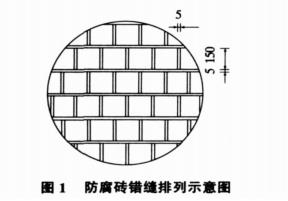
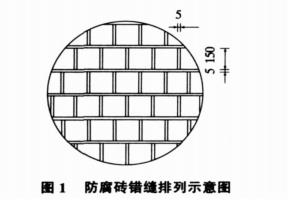
At the same time, cross joints should not appear when laying flat block materials. When laying masonry materials on the facade, considering the clearance size of the water tank structure in this project, horizontal through joints left, but vertical brick joints should stagger with each other.
When laying the intersection of the plane and the facade, the facade block at the hidden corner should press down on the plane block. The flat block at the corner should press down on the vertical block. When laying more than one layer of blocks, the vertical and horizontal corners of the blocks should staggere without overlapping seams. The schematic diagram shown in Figure 1.
Quality requirements and inspection
1) The variety, specification and grade of acid resistant brick board should meet the design and specification requirements.
2) The bonding material in the block bonding layer and mortar joints should be full, dense, and firmly bonded without any looseness, cracks, bulges, or other phenomena. The surface of the block material and the mortar joint should be smooth and undamaged. The size of the mortar joint should meet the relevant requirements of various bonding materials.
3) The paving of block materials should not have cross joints. Multiple layers of block materials should not have overlapping joints.
4) The surface of the block material should be flat. Use a 2m ruler to check in all directions that the gap between the concave part of the surface layer and the ruler should not exceed the following values: acid resistant brick surface layer: 4mm.
5) The height difference between adjacent blocks in the surface layer of the block material should not exceed the following values: acid resistant brick (board) surface layer: 1mm.
6) The slope of the block ground should meet the design requirements, with an allowable deviation of ± 0.2%. The maximum allowable deviation value should not exceed 30mm. During the water splashing test, the water should be able to smoothly drain.
7) When laying the surface layer of anti-corrosion brick materials using resin mortar for jointing, excess chloroprene latex cement mortar in the joints should scrap off at any time; Before pointing, the mortar joints should clean thoroughly. 8) After the construction of block paving, wet curing should be carry out in a timely manner for 3-7 days, and then dry curing should carry out until 28 days.