What are acid resistant ceramic bricks?
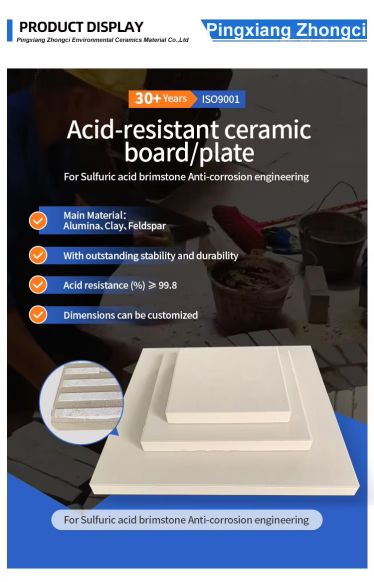
Acid resistant ceramic bricks are anti-corrosion and acid resistant materials mainly made of quartz, feldspar, and clay, which fired at high temperatures in kilns. They have high acid resistance, low water absorption, are not easily oxide at room temperature, and are not easily contaminate by media.
Acid resistant bricks: pressure resistant, corrosion-resistant, easy to clean, acid and alkali resistant;
Acid resistant bricks are widely use in industries such as petroleum, chemical, pharmaceutical, food, dairy, juice, papermaking, fertilizers, pesticides, synthetic fibers, textiles, smelting, power plants, electroplating rooms, as well as anti-corrosion linings for towers, pools, tanks, and troughs. They also play a corrosion-resistant role in sewage treatment projects and outdoor work sites.
What are the characteristics of acid proof bricks
Industrial acid resistant bricks, with a gap width of about 8-10mm, should be flush with the brick thickness to prevent leakage; After the tiling completed, the surface should be wash with groove acid to help make it more secure.
This product is widely use in petroleum, chemical, metallurgical, electric power, synthetic fiber, papermaking, pharmaceuticals, fertilizers, food, dairy, juice, electroplating rooms, as well as anti-corrosion projects such as towers, pools, tanks, and tanks. It can also demonstrate its corrosion resistance in underground sewage systems and outdoor work areas.
Acid resistant bricks generally made of epoxy resin, acid resistant adhesive, and acid resistant cement. When laying, the construction can carry out according to the manufacturer’s product manual mentioneabove;
Clean the concrete surface with oxalic acid to achieve acid-base neutralization;
Reasonable construction conditions for acid resistant bricks
with a construction environment temperature of 15-30 ℃ and a relative humidity not exceeding 80%. When the temperature is below 10 ℃, thermal insulation measures should take.
But direct heating with open flames or steam should not use. When in contact with water, water vapor and fire are not allow in the building environment.
Outdoor construction projects should be equip with rain and sun protection measures.
The preparation and construction of acid resistant ceramic tile raw materials should be carry out according to the construction task.
And the required raw materials should be store before construction.
Before construction, the necessary raw materials (such as resin, curing agent, solvent, plasticizer, filler, and fiberglass cloth) should be inspect to ensure that they meet the construction requirements and are within their validity period.
And separately in designated warehouses; Flammable and explosive acid resistant ceramic tile materials, such as acetone, solvents, toluene, accelerators, etc., should store separately in fire-resistant and explosion-proof warehouses.
The main component of acid resistant bricks is silicon dioxide, which forms a large amount of multi alumina tourmaline under high temperature calcination.
This is a substance with high acid resistance. Due to the compact structure and low water absorption rate of acid resistant ceramic tiles.
They can withstand any concentration of alkaline media at room temperature, but are not resistant to high temperature molten alkali Acid resistant ceramic tiles contain more than 70% silicon dioxide and sintered.
They are commonly use in the chemical industry for building acid ditches, acid wells, acid storage tanks, and high acid bearing impact floors.
Testing method for acid resistant bricks
Acid resistant cement in acid resistant bricks is a powdery material by grinding acid resistant fillers and hardeners in an appropriate ratio.
After mixing with an appropriate amount of water glass solution during use, it can harden in the air and has the ability to resist most inorganic acids and acid corrosion.
The sieve residue of 0.080mm square hole sieve shall not exceed 15%.
The initial setting should not be earlier than 30 minutes.
The final setting should not be later than 8 hours, and air curing should be carry out in room temperature acid and boiling acid Good stability.
The acid resistance is greater than 91%.
The flexural strength shall not be less than 1.96Mpa after 28 days, and the kerosene absorption rate shall not exceed 10%.
Not applicable to projects that are susceptible to corrosion from hydroxyl acid, fluorosilicic acid, hot phosphoric acid above 300 ℃, fatty acids, oleic acid, palmitic acid, as well as alkali or alkaline salts.
After curing and drying for 5-10 days and nights, acidification treatment should carry out by brushing the surface with 40% sulfuric acid every 4 hours.
The crystals that precipitate each time should scrap off before the next coating until they precipitate. Generally, it needs to paint four times.