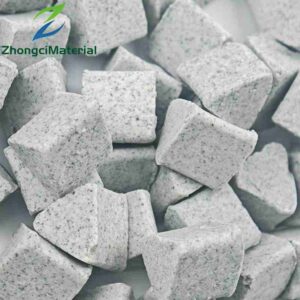
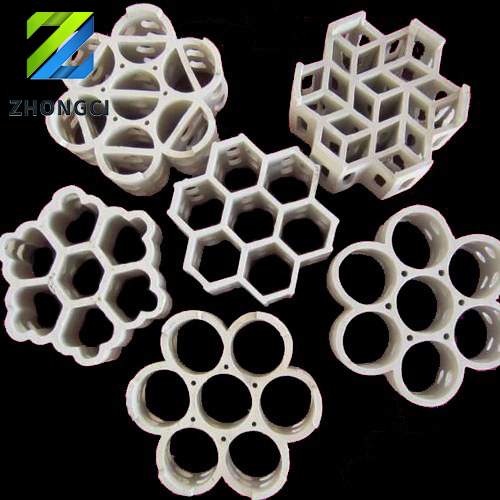
Ceramic structured packing is a new type of high-efficiency packing widely used in coking desulfurization, methanol, benzene washing, naphthalene washing, ammonia washing tower, and fertilizer hot water saturation tower. This series of fillers has a large specific surface area, high porosity, high mass transfer coefficient, resistance to blockage, corrosion, rapid cooling and heating, long service life, and easy installation. Ceramic structured packing has also successfully solved the contradiction between porosity and specific surface area, which is not easy to block the tower and has good performance, making it the best choice for packing tower users.
New type of light ceramic structure packing
The new type of light ceramic regular packing has a rich microporous structure, high apparent porosity, strong adhesion and adsorption ability to various impurities in process media such as gas and liquid, and good purification effect. The new type of light ceramic regular packing has a light packing density (280-340kg/cm3), which is much lower than the packing density of general ceramic packing and metal packing. The product has a high packing porosity (≥ 72%), with a total porosity of over 85%. Therefore, it has the advantages of light packing tower weight, low load, low operating resistance, and pressure reduction.
The characteristics
The volume density of the new all ceramic regular packing is 2.3-2.6g/cm3, and the packing density is 0.32-0.48g/cm3. The product has a packing porosity of up to 72% -80%, and its mass transfer coefficient is high, twice that of general ceramic packing. After the filling completed, the overlapping of six adjacent support legs of the filling material forms an ineffective area, and the form of gas-liquid transmission is “surface” contact. In addition, the filling material is a honeycomb shape ceramic structure with a high spatial flow area, which makes the effective area of the filling material greater than 98.5% and achieves separation and purification effect.