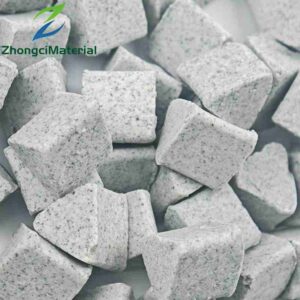

Ceramic saddle ring, also known as ceramic irregular saddle ring or ceramic saddle packing, is an improved packing product developed from the ordinary rectangular saddle ring.
I. Origin and Design Improvement
In the 1970s, the American Noton Company made improvements to the ordinary rectangular saddle ring packing. It changed the fan – shaped arc surface into a serrated shape and added openings on the saddle back. This design expands the void ratio of the packing layer, making the packing layer more unobstructed, improving the liquid distribution performance, reducing the gas – passing resistance and pressure drop, and enhancing the mass transfer efficiency.
II. Physical and Chemical Properties
- Material Composition: It mainly made of aluminosilicate acid – resistant and heat – resistant ceramic materials. The main components are silicon dioxide (SiO₂) with a content of 66 – 75% and aluminum oxide (Al₂O₃) with a content of 18 – 40%. Its material density is 2.3 – 2.35 g/cm³, and it can withstand temperatures of ≥ 1280℃.
- Chemical Resistance: It has excellent chemical resistance. It can resist the corrosion of various inorganic acids, organic acids, and organic solvents, except hydrofluoric acid. The acid resistance is ≥ 99.9%, and the alkali resistance is ≥ 88%.
- Physical Performance: It has good mechanical strength, with a compressive strength of ≥ 10 N/mm. Also, it has excellent rapid cooling and heating performance, which can maintain stable performance in harsh working environments.
III. Structural Features
The smooth arc – shaped side of the rectangular saddle packing changed to a serrated or corrugated convex side. There are many internal voids for isolation, providing multiple channels for liquid to pass through. The liquid can quickly pass through the saddle – shaped pipeline, adsorbed on the surface of the packing, and stay there for a long time, thus avoiding blockage. This structure also increases the contact voids between packings in the packing bed, which is more conducive to the flow and dispersion of gas and liquid in the packing layer.
IV. Application Fields
- Chemical Industry: It widely used in the drying towers, absorption towers, cooling towers, washing towers, and regeneration towers in the chemical industry. For example, in the production process of sulfuric acid (H₂SO₄), it can use as a packing in the absorption tower to improve the absorption efficiency of sulfur trioxide.
- Metallurgical Industry: In the metallurgical process, it can use in the purification and treatment of flue gas in various furnaces, such as the absorption and treatment of harmful gases in the flue gas of blast furnaces and converters.
- Gas Industry: In the gas purification and treatment process, it can be in the washing towers and absorption towers to remove impurities and harmful substances in the gas.
- Environmental Protection Field: It often use in waste gas treatment devices, such as RTO regenerative incinerators in the environmental protection field, to help remove harmful gases and protect the environment.
- Other Industries: It is also applicable to the oxygen – making industry, coking industry, and chlor – alkali industry. For example, in the oxygen – making process, it can use in the purification and drying of oxygen – containing gases.
In conclusion, the ceramic saddle ring, with its excellent performance and unique structure, has become one of the most widely used dumped packings at present, playing an important role in various industrial fields.