Carbon molecular sieve (CMS) is a versatile material with a wide range of applications across various industries. Its unique porous structure and selective adsorption properties make it highly valuable in gas separation, purification, and other processes.
Gas Separation of Carbon molecular sieve uses
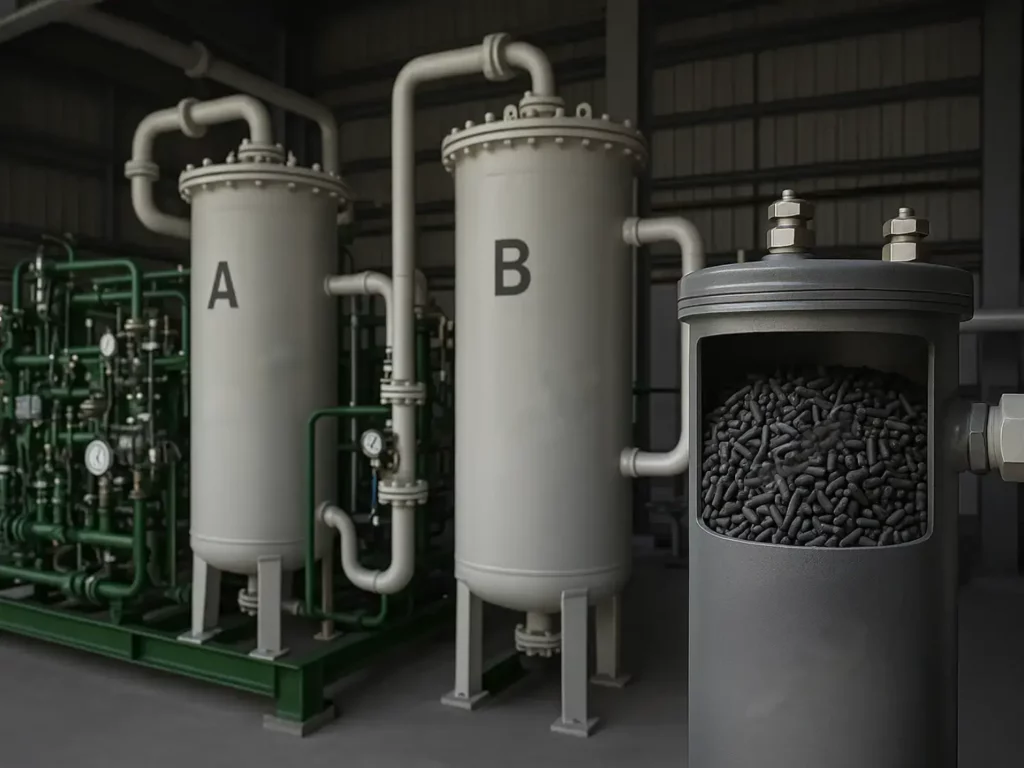
- Nitrogen Production: One of the primary uses of CMS is in pressure swing adsorption systems for nitrogen generation. Compressed air, after removing oil, water, and dust, enters an adsorption container filled with CMS. The CMS selectively adsorbs oxygen and other contaminants, allowing nitrogen to pass through, thus producing high-purity nitrogen.
- Air Separation: CMS is employed in separating oxygen and argon from air. Studies have focused on the adsorptive rates of O₂, N₂, and Ar on CMS, as well as the PSA performance for air separation and the characterization of CMS.
- Radon and Xenon Separation: The dynamic adsorption properties of radon and xenon on CMS are distinctly different, enabling their separation.
Membrane Technology
- Carbon Molecular Sieve Membrane (CMSM): CMSMs are a type of inorganic membrane with excellent performance. They are prepared by coating a support with a solution containing materials like novolac phenol formaldehyde resin and then carbonizing. These membranes are used in gas separation, with applications such as separating H₂/CH₄ and H₂/N₂. For example, prepared CMSMs have shown H₂/CH₄ separation coefficients up to 171 and H₂/N₂ separation coefficients up to 74. Computer simulation studies on the gas separation mechanism of CMSMs, including the development and selection of simulation methods and non-equilibrium molecular dynamics, have been conducted.
Other Industrial Applications
- Purification Processes: In purification, CMS, along with activated charcoal, can be used as a dry medium. However, caution is needed as sudden exposure to large quantities of substances like NF₃ may cause rapid exotherms.
- Agricultural Storage: Carbon molecular sieve nitrogen generators are successfully used in controlled atmosphere (CA) storage of fruits like ‘Red Delicious’ apples in natural air cold storage (15 – 0℃). By controlling O₂ (1% – 5%) and CO₂ (1% – 6%) levels, they inhibit ACC conversion and ethylene production, maintain fruit quality, reduce weight loss, control(peel scald), and extend shelf life.
Research and Development Areas
- Adsorption Desulfurization: CMS is part of research into adsorbents for gasoline adsorption desulfurization, along with activated carbon, molecular sieve, metal oxide, and clay materials.
- Catalyst Support: There is exploration into using CMS – related materials in catalytic processes. For instance, a method for producing a mixture of ethylene and carbon monoxide involves using a catalyst comprising synthetic cryptomelane or octahedral molecular sieve with ethane and an oxygen source.
- Performance Enhancement: Studies are ongoing to improve CMS performance. For example, investigating the influence of carbonization conditions and iron series additives on CMS performance, and studying the adsorption and diffusion of oxygen and nitrogen in CMS samples for air separation using gravimetric methods, which indicate that the diffusion process is activated and can be represented by a dual diffusion resistance model.
In summary, carbon molecular sieve uses span gas separation, membrane technology, purification, and catalysis, driven by its tunable adsorption properties and cost-effectiveness, especially with coal-based raw materials.