1. Air compression purification process by carbon molecular sieve
It is very necessary for pure raw air to enter the cms adsorption tower. since particles and organic atmosphere entering the adsorption tower will block the micro-pores of the carbon molecular sieve.
And it will gradually reduce the separation performance of the carbon molecular sieve.
The methods for purifying raw air include: 1. keeping the inlet of the air compressor away from places with dust, oil mist and organic atmosphere.
The raw air, after treated by a refrigerated dryer, adsorbent purification system, etc., enters the carbon molecular sieve adsorption tower.
2. Concentration and gas production of product nitrogen
Carbon molecular sieve is to produce nitrogen gas. And its N2 concentration and gas production can adjust according to the needs of the user.
When the gas production time and operating pressure are ok, reducing the gas production will increase the N2 concentration.
Otherwise, the N2 concentration will decrease. Users can adjust according to their actual needs.
3. Equal pressure time
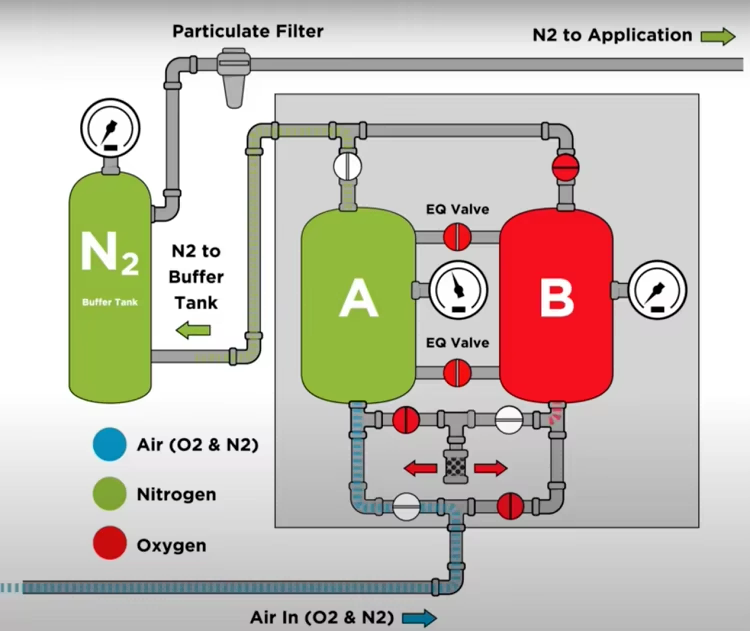
The process of nitrogen production using CMS involves injecting pressurized gas from one adsorption tower into another tower from both directions.
When the adsorption completed, and ensuring that the gas pressure in both towers is the same. This process is called pressure equalization in the adsorption tower.
By selecting an appropriate equalization time, energy can recover.
The impact on the molecular sieve in the adsorption tower can be reduced. Thereby extending the service life of the carbon molecular sieve.
The switching speed of the reference valve is generally selected with a pressure equalization time of 1-3 seconds.
- Gas production time
According to the different absorption and diffusion rates of oxygen and nitrogen by carbon molecular sieves, their adsorption of O2 reaches equilibrium in a short period of time.
At this time, the adsorption amount of N2 is very small.
And a shorter gas production time can effectively improve the gas production rate of carbon molecular sieves.
but at the same time, it also increases the operating frequency of the gate, so the performance of the gate is also important.
Generally, the adsorption time is chosen to be 30-120 seconds.
It is recommended to use a short gas production time for small high-purity nitrogen generators, and a long gas production time for large low concentration ones.
- Operating pressure
Carbon molecular sieves have both dynamic effects and equilibrium adsorption effects, with high adsorb partial pressure and adsorption capacity.
Therefore, pressurized adsorption is advantageous. However, if the adsorption pressure is too high, the selection requirements for air compressors also increase.
In addition, the adsorption pressure requirements for atmospheric regeneration and vacuum regeneration processes are different.
Taking into account various factors, it is recommended that the adsorption pressure for atmospheric regeneration process be selected as 5-8Kg/cm2.
The optimal adsorption pressure for the vacuum regeneration process is 3-5Kg/cm2.
- Usage temperature
Choosing a lower adsorption temperature as an adsorbent is beneficial for the performance of carbon molecular sieves.
In the nitrogen production process, it is advantageous to lower the adsorption temperature when conditions permit.