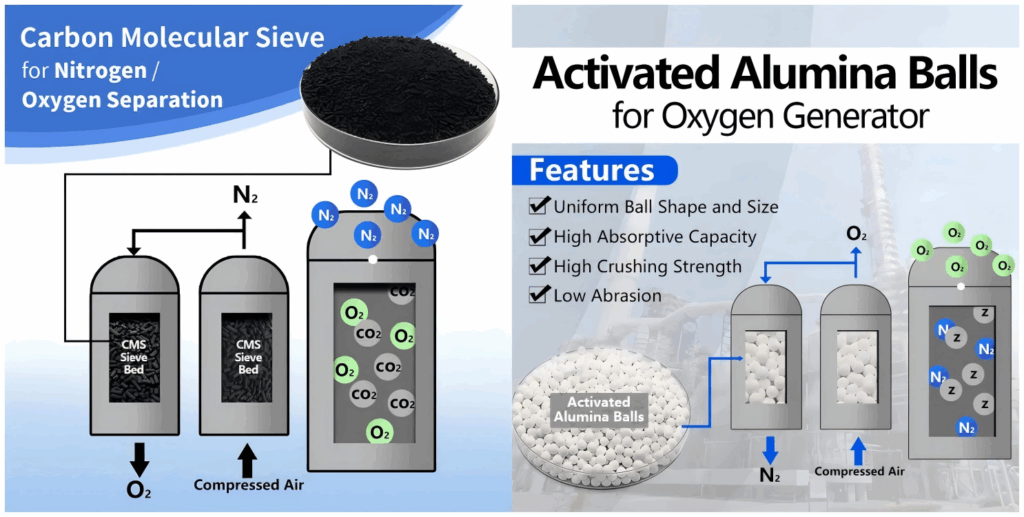
Combining Carbon Molecular Sieve and Activated Alumina leverages their complementary properties for enhanced gas separation, purification, and drying processes. This tandem system is widely adopted in industrial applications requiring precise control over moisture, oxygen, nitrogen, and other gas components.
1. Core Functions of of Carbon Molecular Sieves and Activated Alumina
- Carbon Molecular Sieve (CMS):
- Mechanism: Separates gases (e.g., O₂/N₂) based on kinetic diameter differences. Oxygen molecules diffuse faster into micropores (< 0.5 nm), while larger nitrogen molecules are excluded.
- Applications: Air separation for nitrogen generation , removal of radon/xenon, and CO₂/CH₄ separation.
- Key Property: Tunable pore structure via carbonization conditions (e.g., temperature, additives like iron) .
- Activated Alumina:
- Mechanism: Adsorbs water vapor and polar compounds through high surface area (200–300 m²/g) and hydrophilic sites.
- Applications: Gas drying (e.g., compressed air systems), acid gas removal, and catalyst support.

2. Why Combine Carbon Molecular Sieve & Activated Alumina?
- Pre-Purification: Activated alumina removes moisture and contaminants before gas enters the CMS bed. Water poisons CMS micropores, reducing separation efficiency.
- Extended Lifespan: Protecting CMS from humidity and impurities minimizes degradation, lowering operational costs.
- Integrated Systems: Used in tandem for:
- Nitrogen Generators: Alumina dries compressed air; CMS isolates N₂ via adsorption.
- Natural Gas Processing: Alumina dehydrates gas; CMS removes CO₂ or N₂.
3. Industrial Implementation of Carbon Molecular Sieve & Activated Alumina
- Adsorption Bed Design:
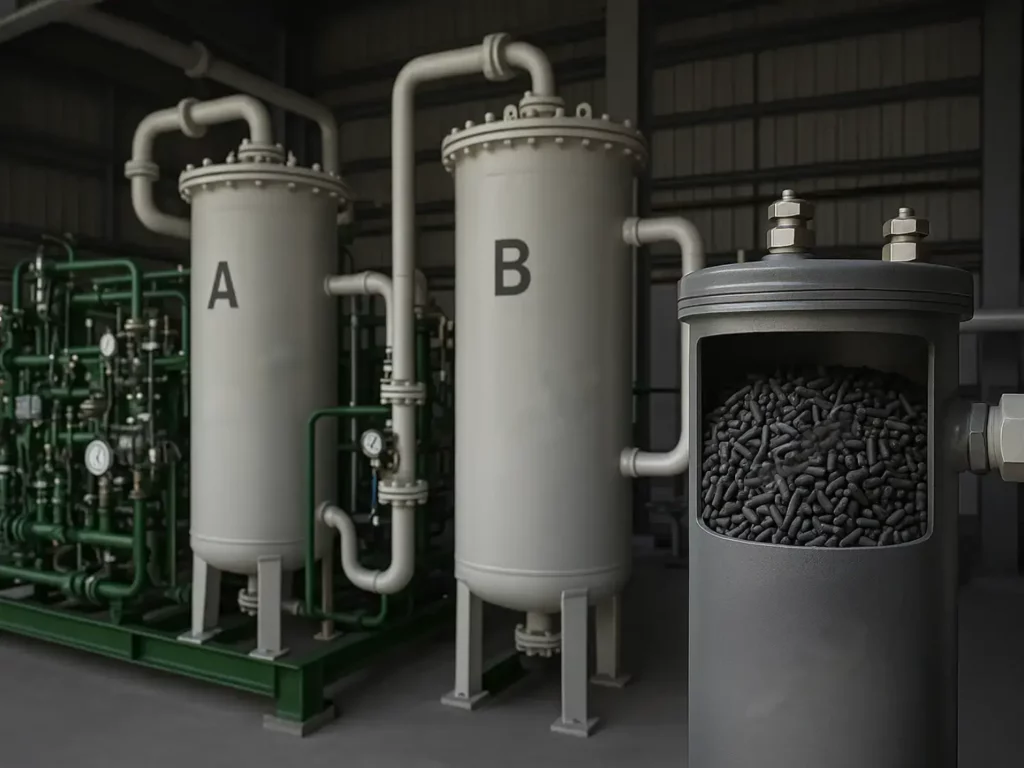
- Layer 1: Activated Alumina for bulk moisture removal.
- Layer 2: CMS for targeted gas separation (e.g., O₂/N₂).
- Regeneration: Both materials regenerate via pressure swing adsorption (PSA) or thermal desorption.
4. Technical Advantages of Carbon Molecular Sieves & Activated Alumina
- Efficiency: CMS achieves >99.5% nitrogen purity in dry conditions.
- Cost-Effectiveness: Coal-based CMS precursors (e.g., petroleum coke) reduce raw material costs.
- Stability: Activated alumina maintains performance in high-humidity environments.
5. Example Applications of Carbon Molecular Sieve & Activated Alumina
- Air Separation Units: Combined system for high-purity N₂/O₂ production.
- Biogas Upgrading: Alumina removes H₂S and moisture; CMS separates CO₂ from CH₄.
- Nuclear Industry: CMS isolates radon after alumina pre-drying.
Conclusion
Integrating Carbon Molecular Sieves and Activated Alumina creates a robust solution for complex gas separation challenges. The synergy enhances efficiency, longevity, and purity across industries—from manufacturing to energy. For deeper technical insights, refer to sources on CMS synthesis 1 and gas diffusion mechanics