Overview of CMS-HP Carbon Molecular Sieve
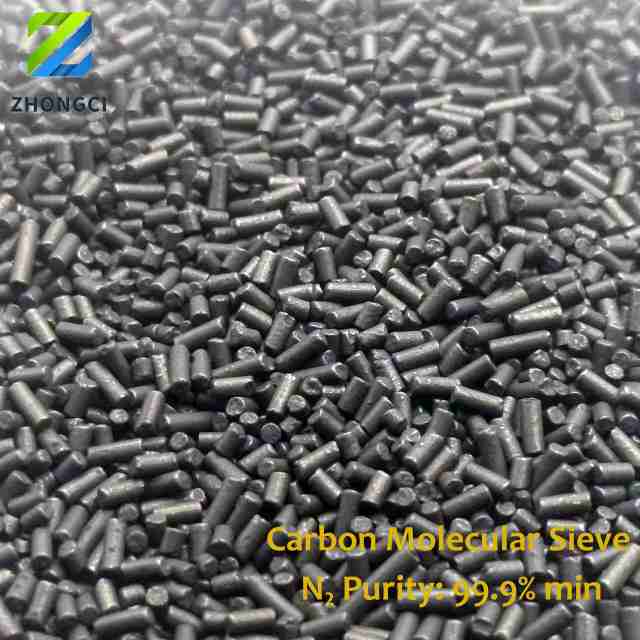
The pore size of CMS-HP carbon molecular sieve mainly composed of micropores below 1nm and a small amount of macropores, with uniform pore size distribution, high chemical stability and gas selectivity.
Working Principle of CMS-HP Carbon Molecular Sieve
When the molecular sieve adsorbs impurity gases, macropores and mesopores only act as channels to transport the adsorbed molecules to micropores and sub-micropores, and micropores and sub-micropores are the real adsorption volumes. The interior of CMS-HP contains a large number of micropores. These micropores allow molecules with small kinetic size to diffuse into the pores quickly, while restricting the entry of large-diameter molecules. Due to the difference in relative diffusion rates of gas molecules of different sizes, the components of gas mixtures effectively separated.
Application of CMS-HP Carbon Molecular Sieve
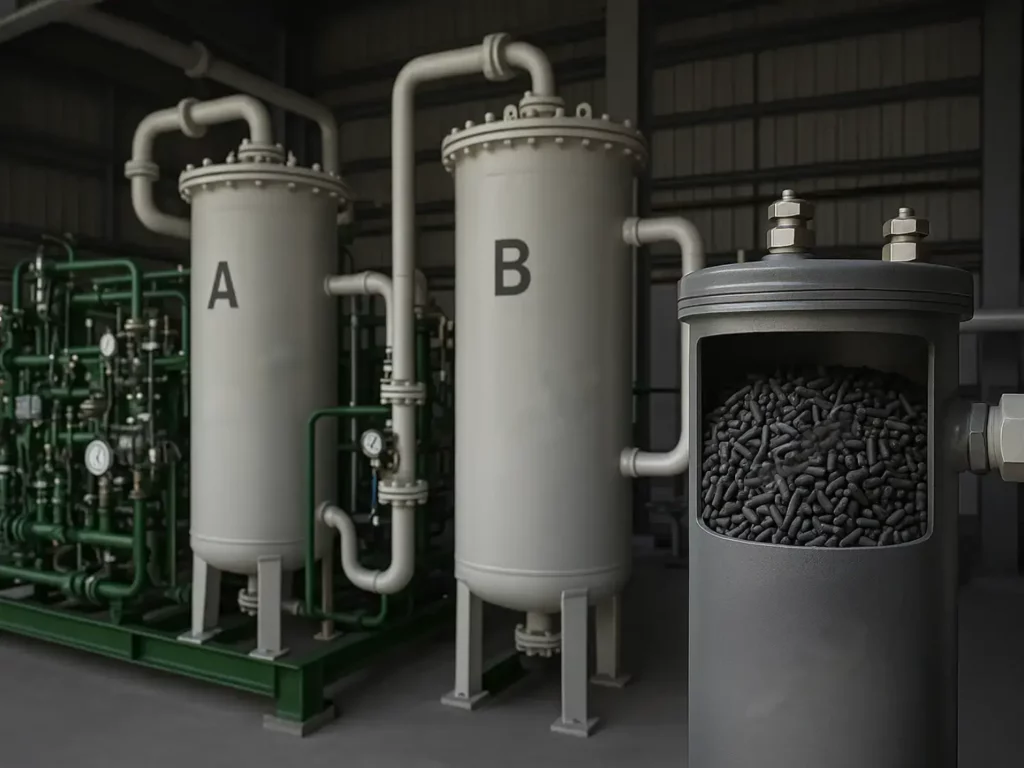
- Nitrogen production: Nitrogen-making carbon molecular sieve contains a large number of micropores with a diameter of 4 angstroms. These micropores have a strong instantaneous affinity for oxygen molecules (the diffusion rate of oxygen is much higher than that of nitrogen), so they can be to separate oxygen and nitrogen in the air. Industrially, nitrogen produced by pressure swing adsorption (PSA) devices. When compressed air enters the CMS adsorption tower, as the reaction pressure increases, the diffusion rates of O₂ and N₂ are different, so the adsorption rate of O₂ greatly exceeds that of N₂ in a short time after the start of adsorption. Therefore, using the characteristic that CMS has different adsorption capacities for O₂ and N₂ within a certain period of time, the cycle process of pressurized adsorption and decompressed desorption controlled by the program controller to complete the separation of O₂ and N₂.
- Other fields: With the increasing global environmental protection pressure, the expansion of the application field of air separation equipment, and the start of projects such as shale gas exploitation, the demand for CMS is increasing, and the performance requirements are also getting higher. CMS-HP carbon molecular sieves can also be in gas drying, purification and other fields.
Development of CMS-HP Carbon Molecular Sieve in China
The research and development of carbon molecular sieve in China began in the 1980s and has a history of more than 30 years. In the early 1990s, Dalian University of Technology systematically studied the preparation theory and technology of air separation CMS, and prepared air separation CMS using weakly cohesive high-volatile bituminous coal as raw material. The technology finally industrialized in Zhejiang. It is reported that the products produced are in a leading position in China and reach or approach the international advanced level. At present, some domestic manufacturers have advanced production experience and can produce high-quality CMS-HP carbon molecular sieves, which can meet the needs of different fields