Overview of carbon molecular sieve in china
Carbon molecular sieve (CMS) China are advanced porous materials with well-developed structures containing micropores (>20 Å), ultramicropores (~7 Å), and submicropores (~4 Å), enabling exceptional gas separation performance. These materials are typically initially characterized as thick (50–100 μm) self-supporting isotropic films but require conversion into thin selective layers (a few micrometers or less) for practical applications. China has emerged as a significant player in CMS research and development, focusing on both material optimization and industrial applications.
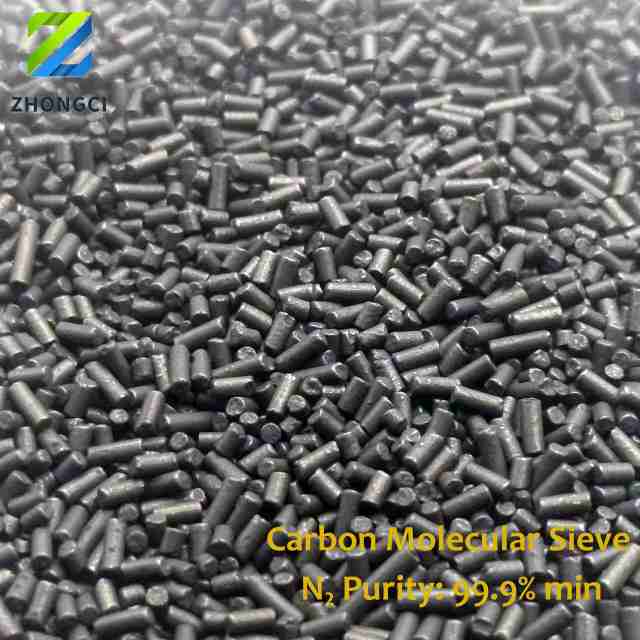
Key Properties and Separation Mechanisms
- Structural Advantages: The hierarchical pore structure of CMS allows precise size-based separation of gas molecules. For instance, CMS exhibits distinct dynamic adsorption differences between radon and xenon, facilitating their separation.
- Gas Transport Behavior: Oxygen and nitrogen diffusion in CMS follows an activated process described by the dual diffusion resistance model. Even after 28 days of physical aging, thin CMS films maintain favorable permeability-selectivity balances, such as O₂/N₂ selectivity of ~8 with O₂ permeability ~20–30 GPU, and CO₂/CH₄ selectivity of ~100 with CO₂ permeability ~150–300 GPU.
- Thickness Dependence: Reducing film thickness from 100 μm to 0.55 μm affects permeability but retains high selectivity, a critical factor for membrane design.
Preparation and Industrial Applications in China
- Raw Material Advantages: China utilizes coal-based CMS production methods, leveraging abundant and low-cost raw materials. This approach enhances economic viability for large-scale applications.
- Membrane Fabrication: Innovations include coating novolac phenol formaldehyde resin solutions on supports, followed by carbonization to form defect-free CMS membranes. Such membranes achieve H₂/CH₄ separation coefficients up to 171 and H₂/N₂ up to 74.
- Major Applications:
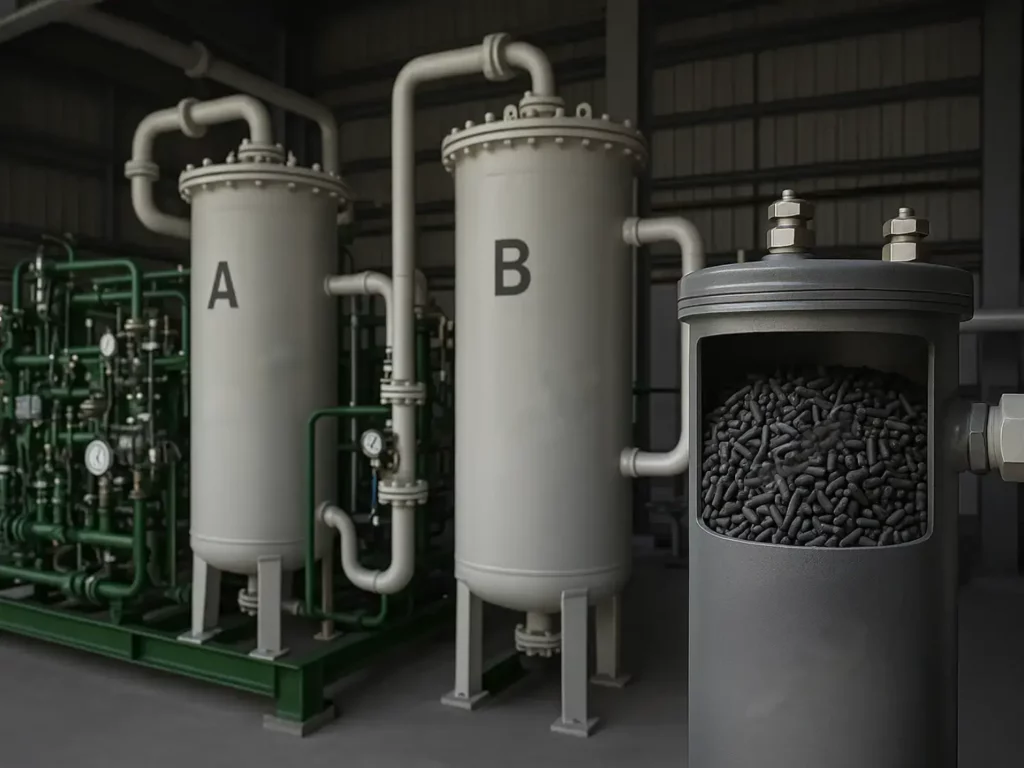
- Air Separation: CMS is widely used in pressure swing adsorption (PSA) nitrogen generators, where compressed air is processed to separate O₂ and N₂.
- Food Preservation: CMS nitrogen generators enable controlled atmosphere storage of fruits like ‘Red Delicious’ apples by maintaining 1–5% O₂ and 1–6% CO₂, inhibiting ethylene production and preserving quality.
- Gas Purification: CMS aids in removing impurities like NF₃ using dry media adsorption, though precautions against exothermic reactions are necessary.
Research Progress and Future Directions
- Simulation Studies: Chinese researchers employ non-equilibrium molecular dynamics to simulate gas separation mechanisms, optimizing membrane performance.
- Material Innovation: Development of hydroxyl-functionalized polyimide precursors (e.g., 6FDA-HTB) has yielded CMS membranes with improved stability and separation efficiency.
- Challenges: Ongoing efforts focus on mitigating thickness-dependent property variations and enhancing long-term aging resistance for industrial reliability.
China’s advancements in CMS technology, from laboratory research to industrial deployment, highlight its role in driving global progress in gas separation materials and applications.