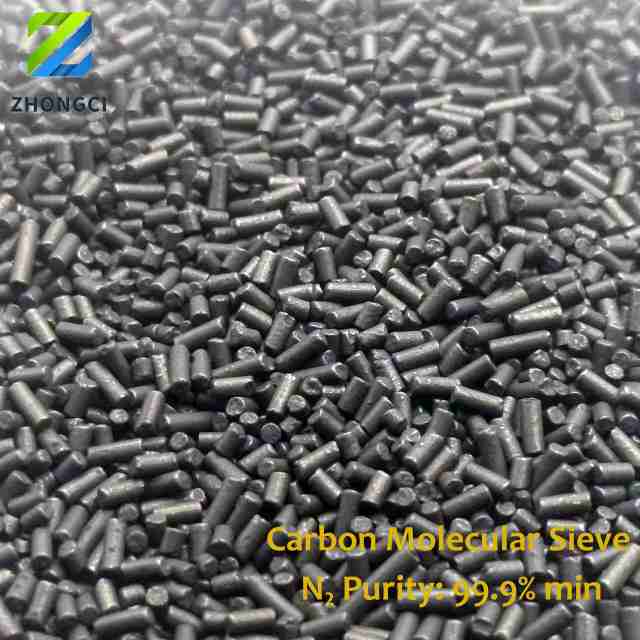
(CMS) Carbon molecular sieve is a type of porous carbon material with precisely controlled pore structures, primarily composed of carbon atoms arranged in a disordered framework with interconnected micropores (typically <2 nm). It exhibits molecular-sieving properties by selectively adsorbing or separating molecules based on size, shape, and polarity. This makes it widely used in gas separation, catalysis, and purification fields.
Preparation Methods of CMS Carbon molecular sieve
- Carbonization and Activation: Traditional CMS is prepared by carbonizing carbon-rich precursors. and they are (coal, petroleum coke, biomass) followed by physical or chemical activation.
- For example, Ningxia coal mixed with wood tar as a binder is pressure-molded and carbonized to form molecular-sieve type activated carbon. Where carbonization conditions significantly affect pore size distribution. Daqing petroleum coke activated with KOH under optimized conditions (alkali/carbon ratio, activation temperature, time). And it yields CMS with a specific surface area exceeding 3000 m²/g.
- Polymer Pyrolysis: Polymer precursors like PIM-1 (Polymers of Intrinsic Microporosity) are increasingly used. Pyrolysis under inert atmospheres (argon, CO₂, diluted H₂) at controlled temperatures (e.g., 600°C) converts polymers into CMS with tailored microstructures. Dense films or asymmetric hollow fiber membranes can be fabricated. And adding porous organic cage (POC) fillers enhances interfacial compatibility with the polymer matrix, improving porosity and narrowing ultramicropore distribution.
- Surface Modification: Post-treatment methods such as oxidation adjust surface acidity. For instance, surface oxidation of CMS with a mesopore ratio of 85%. And specific surface area >1500 m²/g creates acidic sites distributed as weak (150–240°C), medium (240–340°C), and strong (340–450°C) acids, suitable for catalyst support applications.
Key Properties and Performance
- Pore Structure Control: The microstructure, particularly ultramicropore volume and size distribution, dictates separation performance. CMS derived from PIM-1 pyrolyzed under 4% H₂/CO₂ atmosphere shows widened ultramicropore distribution (pore diameter ~0.49 nm) and increased micropore volume, enhancing mass transport.
- Gas Separation Efficiency: CMS membranes modified with 10 wt% POC fillers exhibit exceptional CO₂/CH₄ separation performance: CO₂ permeability of 2002 Barrer and selectivity of 221.6, surpassing the 2019 Robeson upper bound. This represents a 147.5% increase in CO₂ permeability and 297.1% higher selectivity compared to pristine PIM-1-based CMS membranes, with excellent anti-aging stability (>30 days).
- Solvent Transport Behavior: CMS hydrophilicity influences water-organic mixture separation. PIM-1-derived CMS shows preferential water adsorption, enabling efficient pervaporation and vapor permeation of aqueous-organic systems. Adsorption-diffusion models effectively predict transport in isobaric modes (vapor permeation), while hydraulic permeation is underestimated by 250×.
Applications of CMS
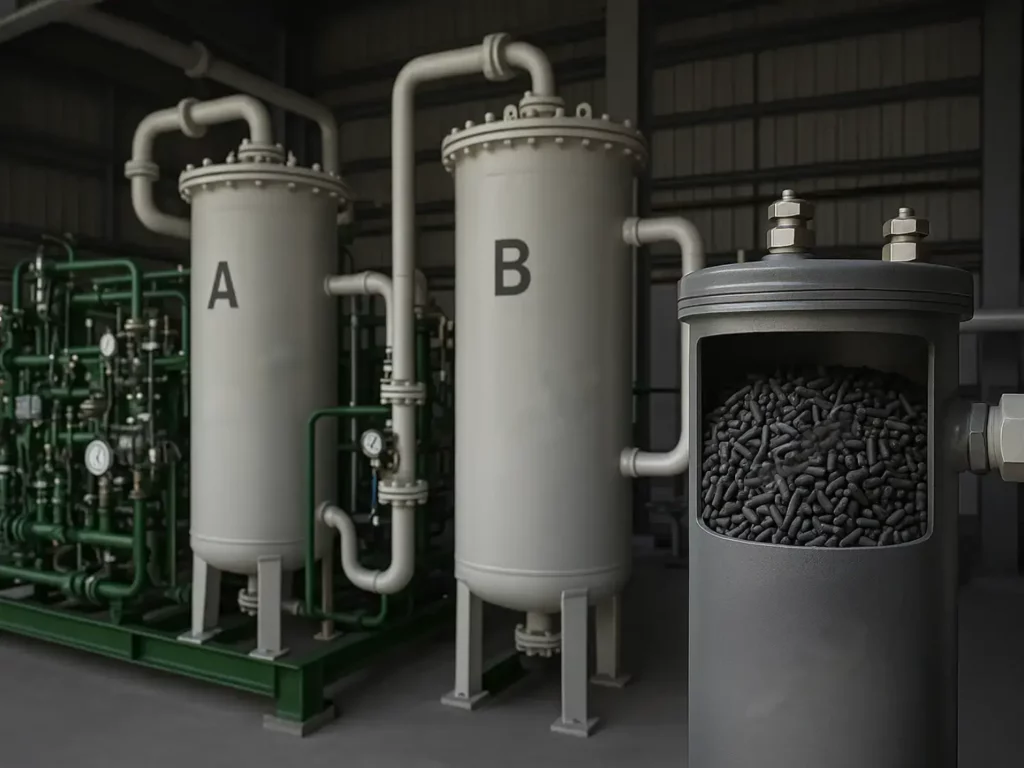
- Gas Separation: O₂/N₂ air separation, CO₂ capture from flue gas, and CH₄ purification. CMS with tailored pores selectively adsorbs smaller molecules (e.g., O₂ over N₂) or polar gases (e.g., CO₂ over CH₄).
- Liquid Separation: Dehydration of organic solvents (e.g., water/paraxylene mixtures) via pervaporation, leveraging CMS microstructure-dependent transport mechanisms.
- Catalysis: Surface-modified CMS with controlled acidity serves as a catalyst support for reactions requiring shape-selective catalysis, such as hydrocarbon isomerization.
- Membrane Technology: CMS membranes, especially hollow fiber configurations, are integrated into industrial separation processes for energy-efficient gas purification and solvent recovery.
Future Development Trends
- Precision Pore Engineering: Advanced synthesis techniques (e.g., templating, in-situ doping) to achieve atomic-level control over pore size and surface chemistry, targeting higher selectivity and permeability for challenging separations (e.g., C₂H₄/C₂H₆).
- Composite Materials: Hybrid CMS systems incorporating metal-organic frameworks (MOFs) or quantum dots to synergistically enhance separation performance and stability under harsh conditions.
- Sustainability: Exploring renewable precursors (lignin, agricultural waste) and green activation methods to reduce environmental impact while maintaining CMS performance.