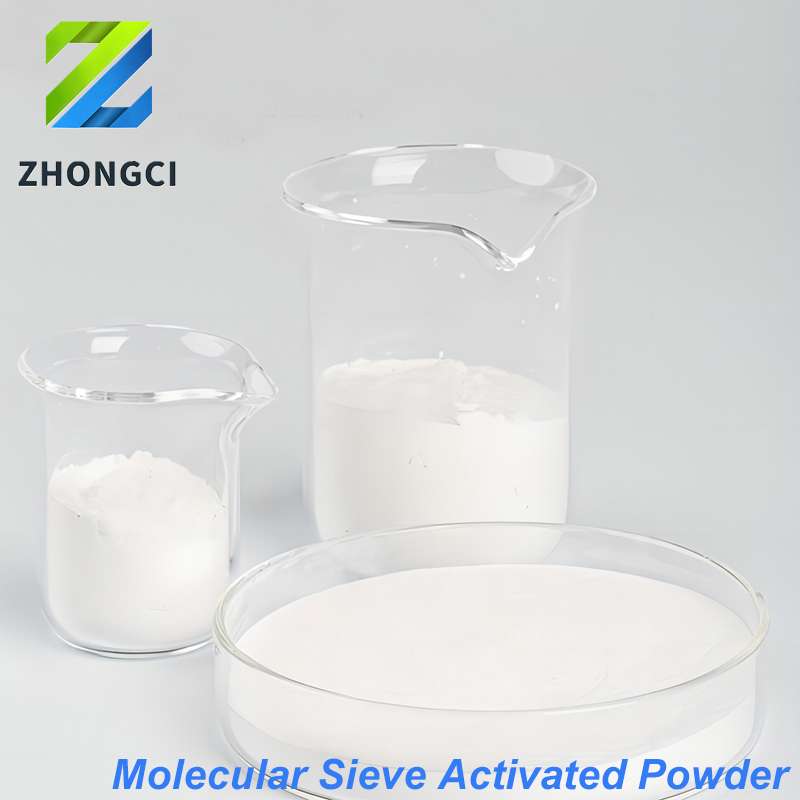
5A Molecular Sieve Activated Powder is a synthetic aluminosilicate zeolite with a uniform pore aperture of 5 Ångströms (Å). Its chemical composition is typically represented as Ca₅Na₂[(AlO₂)₁₂(SiO₂)₁₂]·27H₂O, classified as a calcium-exchanged Type A zeolite. The “activated” designation indicates thermal dehydration to remove adsorbed water, maximizing its adsorption capacity and catalytic reactivity.
2. Key Properties and Advantages of 5A Molecular Sieve Activated Powder
- Selective Adsorption:
Adsorbs molecules with kinetic diameters ≤5 Å, including:- H₂O, CO₂, SO₂ (polar gases)
- Linear alkanes (C₃–C₄ n-paraffins)
- Halogenated compounds (e.g., chloroethane, bromoethane).
Excludes branched-chain or cyclic hydrocarbons due to steric hindrance.
- High Thermal Stability:
Maintains structural integrity up to 600°C, enabling regeneration via controlled calcination. - Powder-Specific Benefits:
- Enhanced Kinetics: Fine particle size (<50 µm) increases surface-area-to-volume ratio, accelerating adsorption/desorption cycles .
- Flexible Formulation: Serves as feedstock for extrusion/pelletizing catalysts or composite membranes.
3. Industrial and Laboratory Applications
- Gas Separation & Purification:
- O₂/N₂ Production: Co-adsorbs moisture and CO₂ from air streams in pressure-swing adsorption (PSA) systems.
- Hydrocarbon Isolation: Separates n-paraffins from iso-paraffins in naphtha reforming raffinates.
- Dehydration: Dries natural gas, ethanol, and refrigerants.
- Catalysis:
Acts as a solid acid catalyst in petroleum refining (e.g., isomerization, cracking) due to its Brønsted/Lewis acid sites. - Analytical Chemistry:
Used in Gas Chromatography (GC) columns (e.g., 5A-packed columns) for separating permanent gases (O₂, N₂, H₂) via molecular size exclusion.
4. Activation and Handling Protocols
- Activation Process:
Heated to 300–350°C under vacuum or inert gas to evacuate pore-occluded H₂O, achieving optimal surface exposure. - Storage Requirements:
Stored in airtight containers to prevent premature moisture adsorption, which reduces efficacy.
5. Performance Comparisons
| Property | 5A Activated Powder | 3A/4A Sieves |
|---|---|---|
| Pore Size | 5 Å | 3 Å / 4 Å |
| Key Adsorbates | C₃-C₄ alkanes, BrEt | H₂O, NH₃ (3A) |
| Catalytic Versatility | Higher | Moderate |
6. Emerging Research Directions
- Bindless Adsorbents: Studies focus on mitigating “coking deactivation” during n-paraffin separation via oxidative regeneration.
- Cryogenic Separation: Explored for H₂/HD isotope partitioning in deuterium purification at 77 K .
References:
- Fundamental properties:
- Catalytic/separative functions:
- Activation protocols:
This engineered material bridges industrial scalability with molecular precision, underpinning sustainable chemical processes and energy technologies. For synthesis specifications, consult manufacturers.